
Long associated with value-driven shopping for budget-conscious consumers, Walmart is undergoing a notable transformation. The retail giant is increasingly attracting higher-income shoppers by expanding its assortment of branded products, investing in store upgrades, and strengthening its fashion credibility.
In recent years, Walmart has made several moves to elevate its apparel business.
The company appointed American fashion designer Brandon Maxwell as creative director for two of its in-house brands in 2021 and debuted a spring 2025 ready-to-wear collection at New York Fashion Week, a first for Walmart.
Through these efforts, the retailer is partnering with established designers and brands to deliver trend-driven clothing at accessible prices.
Walmart has also integrated digital features in stores, such as QR codes throughout select locations, to better connect its online marketplace with in-store shopping.
Now, the company’s latest push into premium products further signals its intent to move beyond its reputation as a discount retailer and position itself as a destination for both value and style, marking a shift from moments like its controversial fake Birkin bag dupe that went viral in late 2024.
Walmart sells designer brands
Walmart (WMT) is now offering higher-end designer fragrances from brands such as Gucci, Dior, Marc Jacobs, and Giorgio Armani.
In apparel, Walmart added several name brands across its men’s, women’s, and children’s categories, including Levi Strauss, Reebok, Wrangler, Champion, Lee, and Justice, alongside private labels such as Scoop, Sofia Jeans by Sofia Vergara, and Time and Tru.
These products are available both in-store and online, according to its website and as personally verified by TheStreet through store visits, reinforcing the company’s omnichannel strategy.
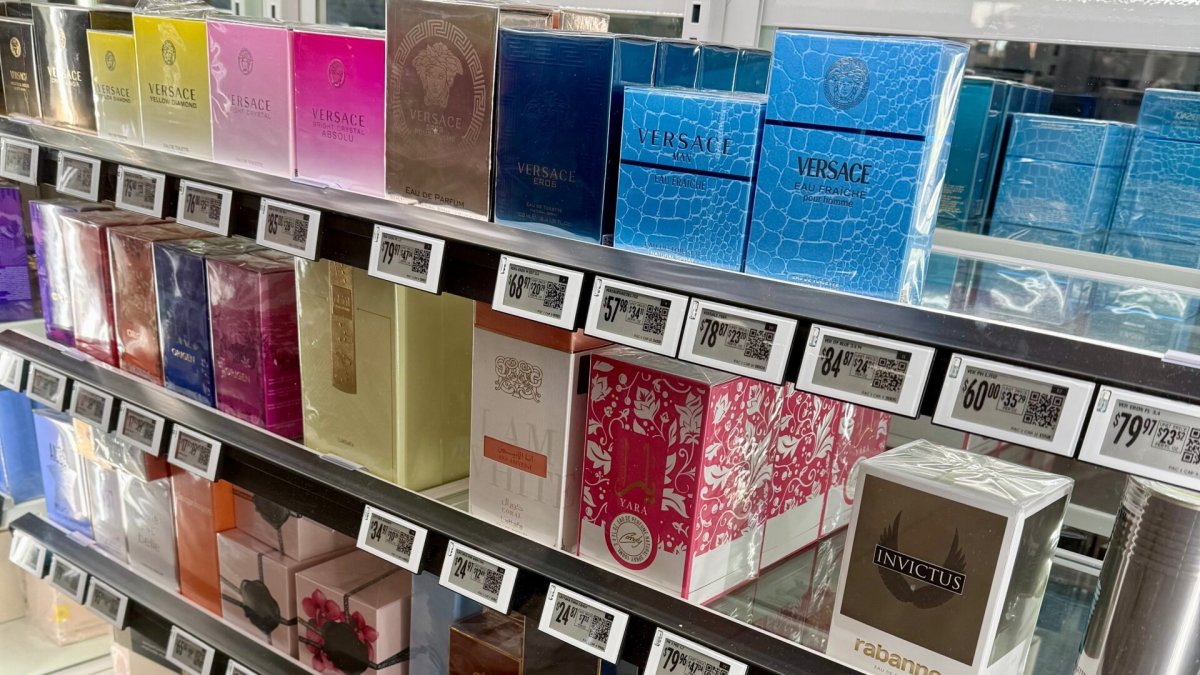 TheStreet verified luxury brand fragrances found inside a Walmart store.
Fernanda Tronco for TheStreet
Walmart invests in stores and infrastructure
In 2024, Walmart launched its “Investing in America” plan, a multi-million-dollar strategy aimed at modernizing stores, creating jobs, and enhancing the customer shopping experience.
The company plans to build or convert more than 150 locations and remodel existing stores over the next five years. It also resumed opening Supercenters in 2025 and introduced its “Store of the Future” concept, with new locations planned across states, including Texas, California, Utah, Alabama, Florida, and New Jersey.
“This store was built with the customer in mind,” said Walmart U.S. CEO John Furner in the company statement. “It’s part of a larger transformation happening across our stores as we reimagine what shopping looks like for the future.”
Walmart accelerates store remodels
Walmart is also accelerating store renovations across multiple states, including Florida, Oklahoma, Texas, Georgia, South Carolina, and Louisiana, to achieve quicker results and minimize customer disruption, according to a company press release.
Instead of prolonged construction timelines, the company is condensing remodels into approximately four weeks by temporarily closing the main sales floors while keeping pharmacies and fuel stations operational.
Nearby stores and online pickup options will help maintain access during the renovations.
Store upgrades vary by location but often include:
- Wider aisles and improved layouts
- Enhanced online grocery pickup and delivery areas
- Upgraded pharmacies
- Digital price displays
- Improved checkout systems
These changes are designed to streamline the shopping experience while supporting growing demand for digital and hybrid retail.
Walmart’s efforts begin to show results
Walmart’s strategy is beginning to deliver measurable results.
In the fourth quarter of fiscal 2026, total revenue increased 5.6% to $190.7 billion, with Walmart U.S. net sales up 4.6%.
Fashion emerged as a strong performer within general merchandise, posting mid-single-digit growth at Walmart U.S., according to the company’s earnings call.
The retail giant also reported continued share gains among households earning more than $100,000 annually, an important indicator that its higher-end positioning is resonating with more affluent customers.
Higher-income shoppers are a key audience because they are typically less sensitive to economic volatility and spend more on discretionary categories, which can help improve margins and basket size.
At the same time, the strategy carries some risk. Expanding into more premium categories can dilute Walmart’s long-standing value perception if not carefully balanced, particularly as it competes with retailers that already have strong brand equity in fashion.
What industry experts say about Walmart’s transformation
Retail analysts and industry experts point to Walmart’s supply chain scale and pricing advantage as key differentiators.
In late 2024, Walmart expanded into New York City with its first-ever fashion-dedicated retail space, featuring its brands Free Assembly and Scoop.
“The shop was exceptionally well curated, prompting me to purchase three items (Scoop),” said Global Purchasing Companies Director and International Retail Strategist Mercedes Gonzalez on LinkedIn.
“I’ve consistently argued that Walmart has the supply chain necessary to seize the fast fashion market share, especially as prices of fast fashion have escalated. Walmart can also cater to a more affluent clientele,” Gonzalez added.
Analysts at Power Commerce, an Artificial Intelligence (AI) E-commerce solution company, say Walmart is redefining affordable fashion.
“With strategic brand acquisitions, an inviting retail environment, and innovative online offerings, Walmart’s renewed approach is resonating with a generation of shoppers desiring both style and value,” said Power Commerce in a study.
More Retail Business News:
- Shein invests $42 million as Amazon’s growth raises the stakes
- Walmart moves to solve a major store frustration
- Costco quietly adds something F1 fans didn’t expect
- Sam’s Club revives shuttered activewear brand, offers lower prices
A key enabler is Walmart’s use of AI-driven inventory systems. By adapting Just-in-Time (JIT) inventory management with data from social media, search trends, and purchasing behavior, the retailer can predict upcoming fashion trends more quickly and respond to evolving demand.
“It mitigates the risk of overproduction and unsold inventory — long the albatross around so many retailers’ necks,” said Forbes AI Expert Contributor Michael Ashley. “…It enables hyper-responsiveness to consumer behavior, enabling businesses to capitalize on fashion’s fickleness with minimal lag.”
Competitors are making similar moves
Walmart is not alone in investing in product assortment and store innovation; several major rivals are making similar moves.
Retailers upgrading their products and stores
- Target (TGT): Introduced AI-powered tools such as Target Trend Brain to develop new merchandise and refresh product lines more frequently, according to TheStreet.
- Amazon (AMZN): Continues to expand its premium and luxury offerings while using AI-powered robotics and automation to improve operational efficiency, according to Business of Fashion.
As competition intensifies, Walmart’s ability to balance affordability with elevated product offerings will likely determine how far it can push into higher-income demographics without losing its core customer base.
Related: Meet the retail giant that’s actually beating Amazon