
Warren Buffett appeared on CNBC’s Squawk Box on March 31 and said something that stopped markets in their tracks. The banking system, he said, is fragile in ways that investors should not ignore.
“The banking system, in some sense is very strong, in other sense, is very fragile,” Buffett told host Becky Quick, per CNBC. “They all affect each other, and the troubles from one can spread over to another.”
The 95-year-old Berkshire Hathaway (BRK.A, BRK.B) chairman, who stepped down as CEO at the start of 2026, said banking system stability should be a top priority for the Federal Reserve. He pointed to JPMorgan Chase’s scale as a sign of both strength and systemic risk.
What Buffett actually said
Buffett described a financial system that is deeply interconnected and vulnerable to panic. JPMorgan, he noted, processes roughly $10 trillion of business per day, mostly unsecured, according to CNBC. That scale, while impressive, is also what makes it dangerous when confidence breaks down.
“The world is very interconnected and everybody panics,” he said. “You can call the biggest investment banking firms and they don’t answer the phone when things get bad enough.”
Related: Warren Buffett delivers blunt response to social media rumor
He used a vivid analogy to describe what happens when fear spreads. “If you yell fire in a crowded theater, everybody runs. It still pays to beat people to the door,” Buffett said, per Advisor Perspectives.
The remarks came as investors have been rattled by a series of recent blowups in credit markets, fueling fears that risks are building on the balance sheets of banks and private credit funds.
Berkshire’s cash position signals caution
Buffett’s warning carries extra weight given what Berkshire is doing with its own money. He told CNBC that Berkshire’s cash and Treasury bills are now north of $350 billion, per CNBC. The company’s Q4 2025 10-K puts the figure at $373.3 billion.
More Warren Buffett:
- One of Warren Buffett’s dividend stocks is key to reopening Strait of Hormuz
- Greg Abel sends Berkshire investors a powerful new signal
- Warren Buffett’s Berkshire warns Americans on housing market
In the same week as the interview, Buffett said Berkshire bought $17 billion in T-bills, per Quiver Quantitative. He also said he made one “tiny” new stock purchase but declined to name it.
That level of cash accumulation is deliberate. Berkshire ended 2025 as a net seller of stocks for the 12th consecutive quarter, its longest selling streak in decades. Buffett has consistently said he is not seeing opportunities priced attractively enough to deploy capital at scale.
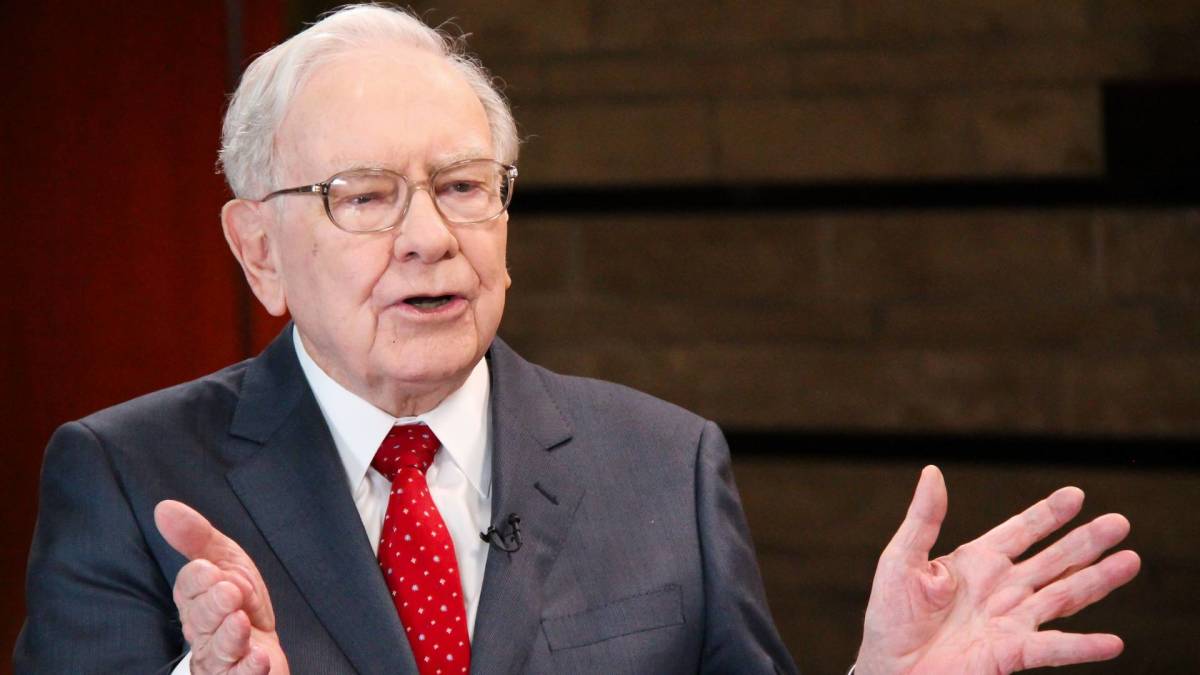 Buffett has stepped out of his CEO role, but has not retired.
Getty Images
The commercial real estate pressure building
Buffett’s concerns about the banking system come as commercial real estate stress is intensifying. The CMBS office delinquency rate hit an all-time high of 12.34% in January 2026, per Trepp via Multi-Housing News. The overall CMBS delinquency rate climbed to 7.47% in the same month.
In March, the volume of CMBS loans more than 30 days past due spiked by $3.08 billion to $45.83 billion, the largest one-month increase since May 2023, per Commercial Real Estate Direct.
Office properties are at the center of the stress. Hybrid work patterns have kept vacancy rates elevated in major cities, and a significant volume of loans are approaching maturity at a time when refinancing conditions remain difficult.
Key stress signals in commercial real estate:
- CMBS office delinquency hit an all-time high of 12.34% in January 2026, per Trepp via Multi-Housing News
- Overall CMBS delinquency reached 7.47% in January, driven by office and multifamily sectors
- CMBS delinquent loan volume rose by $3.08 billion in March, the biggest monthly jump in nearly three years, per Commercial Real Estate Direct
- Including loans past maturity but current on interest, the effective stress rate climbs to 9.14%, per Trepp
Still looking for opportunities, just not seeing them
Despite his caution on the banking system, Buffett was careful not to declare a crisis. He noted that current market conditions fall far short of the dislocations that historically created his biggest buying opportunities.
He remains actively involved at Berkshire even after handing the CEO role to Greg Abel. He told CNBC he still comes into the office daily, calls Berkshire’s director of financial assets before the opening bell, and will not make investments that Abel thinks are wrong, per CNBC.
He also reaffirmed Berkshire’s long-term commitment to Apple (AAPL), which remains the firm’s largest individual equity position and has generated more than $100 billion in gains.
But on the banking system, his message was clear. The interconnectedness that makes large banks so powerful is the same quality that makes them dangerous when things go wrong. And Buffett, sitting on a mountain of cash, is watching carefully.
Related: Warren Buffett’s Berkshire Hathaway shares mortgage warning