
Trade barriers are supposed to be simple machines. You raise the price of a thing until buying it stops making sense, and the buying stops.
Washington built one of the tallest of those walls in modern trade policy around Chinese electric vehicles, and by the only measure most people can see, it worked perfectly.
Chinese automakers now set the global pace in electric cars. BYD (BYDDY) sells more battery-electric vehicles than Tesla (TSLA) does. Xiaomi turns out sedans with cabin technology that makes a Detroit infotainment screen feel like a fax machine. None of it reaches an American dealer lot.
Walk into any showroom in the country, and you will not find one. That absence represents policy working exactly as designed, and most American shoppers have quietly accepted it as the permanent shape of the market rather than a choice someone made.
Nobody protests a car they have never been allowed to test drive. The wall is invisible precisely because it works, and the cost of it shows up as a price tag rather than a headline.
One American company did not accept it, however. It has been buying those cars by the boatload for two years. It is not an automaker, and the vehicles are already carrying paying passengers through Los Angeles, San Francisco, and Phoenix.
Why Chinese electric vehicles stay out of American driveways
The wall against Chinese EVs has three layers, each added for a different reason.
Duties on Chinese electric vehicles were raised to 100% under a Section 301 action, according to the Federal Register notice implementing the change. On top of that sits the standard 2.5% duty applied to imported autos and a 25% charge covering strategic goods, which together bring the stacked rate to roughly 127.5%, Forbes reported.
More Automotive:
- Edmunds finds record cash in used cars
- 124-year-old truck maker cuts 1,341 jobs due to plant sale
- Carvana CEO warns of lower margins amid rising gas prices
Run that against a real vehicle, and the arithmetic gets brutal fast. A van that sells for $39,000 in China lands here at close to $89,000 before anyone bolts a single piece of technology to it.
There is a second barrier that gets less attention. Federal connected-vehicle rules restrict Chinese hardware and software that can collect data on American roads, which means a Chinese car cannot simply be shipped over and switched on.
For readers, this is the reason the cheapest new EV at a U.S. dealership still starts near $30,000, while comparable models sell abroad for half that. The same cost pressure is now spreading into commercial vehicles, a shift I covered in June as Chinese manufacturers turned toward electric trucks.
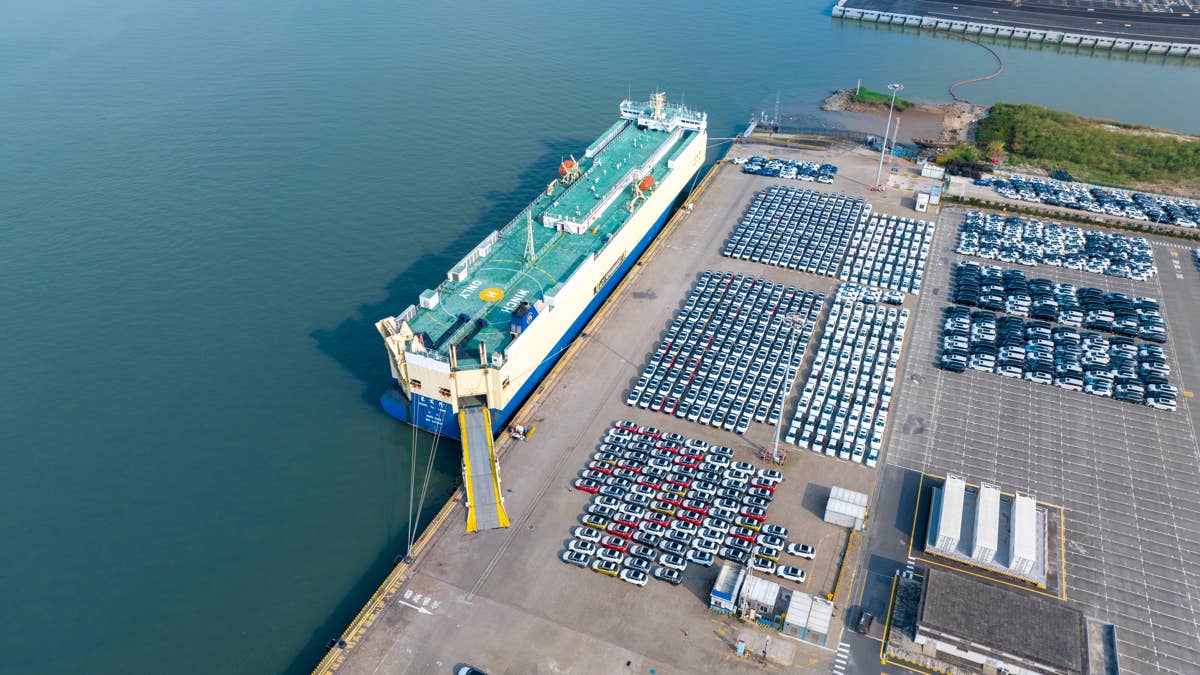 Waymo Chinese EV imports skirt the 127.5% U.S. tariff wall.
Sammyvision / Getty Images
What Waymo is importing through the Port of Los Angeles
Zeekr, the electric brand owned by Geely, has shipped more than 3,200 units of its CM1e van through the Port of Los Angeles since 2024, including over 2,600 in 2026 alone, based on bills of lading compiled by research firm ImportGenius and reported by Forbes.
Waymo is not named on the paperwork, and Zeekr has no other U.S. partner.
Alphabet (GOOGL) subsidiary Waymo calls the van the Ojai, and it began carrying public riders this spring. The company says it is now serving early-access riders in San Francisco, Los Angeles, and Phoenix with more than 300 of them, and that the model will be central to how it scales.
Related: Waymo CEO takes a not-so-subtle shot at Tesla Robotaxi over Lidar
Wall Street had written this vehicle off. Analysts at MoffettNathanson assumed tariffs made the Ojai a dead end, then found import volumes running near 300 vans a month, a pace the firm called “materially higher” than investors expected, Forbes reported.
Compliance is handled at the border, rather than in Detroit. The vans arrive stripped of sensors and computing systems, and Waymo installs its own autonomous hardware at a factory in Mesa, Arizona, the company said.
What the tariff math means for Alphabet shareholders
Here is where my analysis parts company with the coverage I have read so far.
If those 3,200 vans entered at the CM1e’s Chinese retail price, the duty bill alone comes to roughly $159 million, with about $129 million of that landing in 2026. I ran the figures at the full stacked rate, and that number represents a ceiling rather than a receipt.
Declared values are not in the customs records, and a consultant tracking the Chinese auto sector told Forbes that Waymo is probably getting the vans at a steep discount, with Geely possibly absorbing part of the tariff itself. The real number is almost certainly lower. It is still not small.
Set that against what Alphabet actually reports:
- Other Bets generated $382 million in revenue with a $1.8 billion operating loss in the second quarter, according to Alphabet’s earnings call.
- That loss widened from $1.2 billion in the first quarter, based on the same company disclosures, as TheStreet reported from the call.
- Waymo’s fleet totaled about 3,900 vehicles including test cars as of last month, according to a filing with NHTSA.
- Waymo books more than 500,000 paid rides a week and is targeting one million by year end, Waymo said.
Line those up and the picture sharpens. A company with a fleet of roughly 3,900 vehicles has imported 3,200 more since 2024, and it is paying a tariff premium on every one of them, while its parent segment loses money faster than it earns.
That is the tension worth watching. Waymo has to roughly double its fleet to hit its ride target, and the cheapest path to those vehicles runs through the most expensive customs line in the country.
Where the robotaxi race goes next
Waymo is hedging. It is preparing to add modified Hyundai Ioniq 5 hatchbacks built at the automaker’s Georgia plant, which carry no China tariff at all. Amazon (AMZN) unit Zoox, meanwhile, has cleared federal permission for its purpose-built pods and is starting paid service in Las Vegas.
The durable lesson has nothing to do with robotaxis. A 127.5% tariff is not a wall. It is a toll, and tolls sort people by who can pay them.
An individual shopper priced out of a $39,000 Chinese van does not get a second option. A company backed by more than $20 billion in funding writes the check, absorbs the cost inside a segment already losing $1.8 billion a quarter, and puts the car on the road anyway.
If you own Alphabet through an index fund, and most retirement savers do, you are already funding that arbitrage. The question for the next several quarters is not whether Waymo can scale. It is whether the tariff toll shrinks fast enough for scaling to turn into profit.
Watch the Georgia-built Hyundais. When they start showing up in volume, the toll stopped being worth paying.
Related: Waymo vs. human drivers: Experts reveal which is safer