
Jewelry has long been viewed as a one-size-fits-all indulgence. But as precious metal prices surge, fine jewelry has begun to test consumers’ credit card limits and retailers’ margins.
The good news for shoppers on a budget is that more jewelry companies are increasingly redefining affordable luxury by offering high-quality products at more accessible prices.
Founded in 1982 in Copenhagen, Denmark, Pandora has grown into the world’s largest jewelry brand, selling in more than 100 countries. The company’s focus on customizable charm bracelets and attainable luxury designs has helped it become a global powerhouse.
However, Pandora has recently been evolving in ways that could significantly alter its entire business.
Pandora’s first major transformation happened in 2024, when it began crafting its jewelry using 100% recycled silver and gold to reduce its environmental footprint. This move supports its goal of halving greenhouse gas emissions by 2030 and achieving net-zero emissions by 2040, according to its website.
Now the company is preparing to make another significant change, this time targeting one of its most defining materials.
Pandora will begin swapping silver for plated platinum
Pandora (PNDRY) confirmed it will begin introducing platinum-plated jewelry across select product lines, gradually reducing its reliance on silver after sharp price increases over the past year. The shift expands the range of precious metals used in its collections while helping the company manage rising material costs.
“With this innovation, we can navigate the new realities of raw material costs while offering consumers precious metal jewellery that is exceptionally well-suited for everyday wear,” said Pandora CEO Berta de Pablos‑Barbier in a press release. “This strengthens the resilience of our business, while allowing us to present new, finely hand-finished jewellery to the Pandora community.”
The first platinum‑plated pieces will launch in the first quarter of 2026 across 30 stores and online in Northern Europe. A broader global rollout will follow in the second half of 2026, expanding its platinum‑plated bracelets and charms.
By 2027, Pandora expects at least half of its assortment to shift from silver to platinum plating.
The pieces will be produced using Pandora’s Evershine method, introduced in 2015 for gold-plated jewelry, which has now been optimized for platinum plating.
Before making the transition, Pandora conducted a consumer study in July. Among 23,000 participants, 78% recognized platinum as a precious metal, compared with 69% for sterling silver.
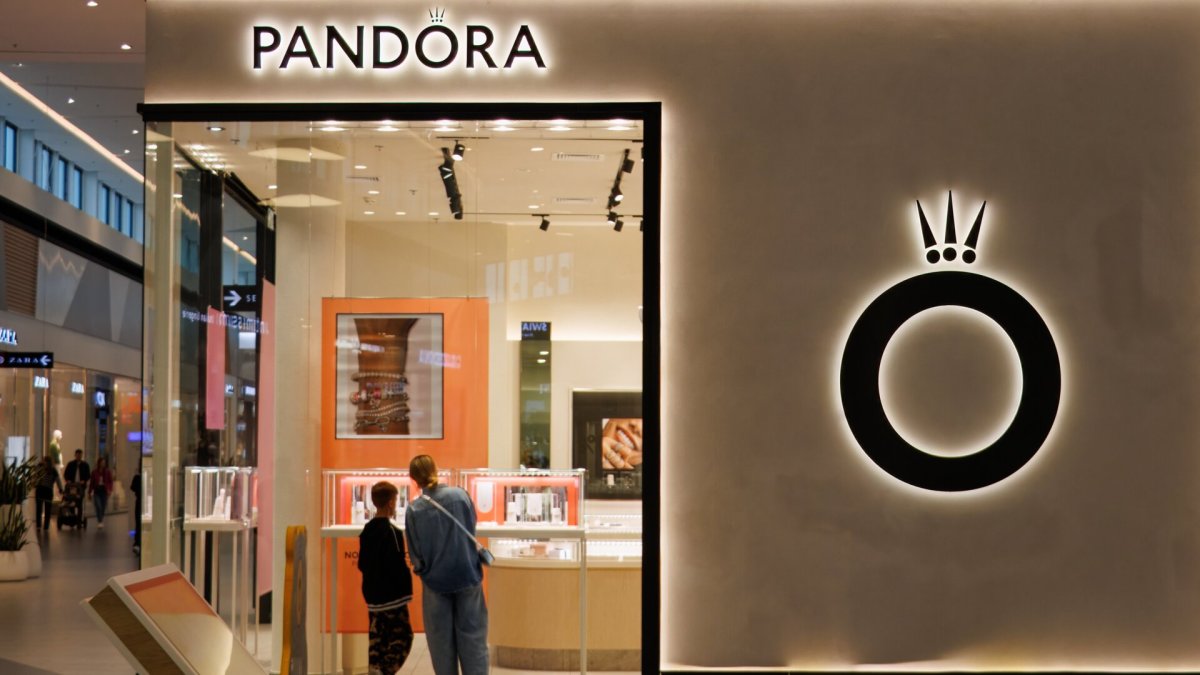 Pandora shifts from silver to platinum-plated jewelry across select product lines amid rising costs.
Pandora delivers weaker-than-expected performance
The announcement comes after Pandora’s full-year performance fell short of the company’s expectations.
In its fourth-quarter 2025 interim report, the company posted 6% total organic growth for the full fiscal year, while same-store sales increased 2%.
Despite its North American same-store sales rising 2%, the company saw traffic slow amid a challenging macroeconomic environment, facing headwinds of commodity prices, tariffs, and foreign exchange rates. North America is a key region for the company, accounting for 36% of total revenue in 2025 and ranking as its second-largest market.
During a recent earnings call, Pablos‑Barbier hinted at upcoming efforts to mitigate material costs but did not fully detail its platinum plating strategy at the time.
“We are also focused on addressing the impact of high silver prices and are moving at pace on actions across new products and materials to protect margins and improve value creation, said Pablos‑Barbier in the earnings call. “It remains significant and taps opportunities for Pandora as a desirable, accessible jewellery brand. And we are moving with discipline and rigour to strengthen brand desirability and position Pandora for long-term value creation.”
When silver prices first began rising, Pandora introduced the Silverstone cost program to manage expenses. However, softer top-line performance in the second half of 2025 heightened the need to find new ways to reduce costs efficiently without compromising marketing spending or product quality.
Precious metals prices skyrocket
The urgency behind Pandora’s material shift reflects a broader trend in global commodities markets.
In 2025, gold prices increased by 65%, silver rose by 150%, and platinum climbed by 121.8%, according to BullionVault. By the end of 2026, forecasters predict the gold price will average $5,136 per Troy ounce, silver will surpass $80 per Troy ounce, and platinum will average $1,826 per Troy ounce.
Analysts attribute the price surge to ongoing geopolitical tensions, including global conflicts and trade tariff disputes involving the U.S., the Middle East, China, Europe, and Latin America, as well as concerns over the Federal Reserve rate cuts and a weakening U.S. dollar, according to The Economic Times.
More Retail Business News:
- Global toy retailer suspends online operations, closes stores
- Target bets on beauty makeover as Ulta exit looms
- Two beloved beauty brands shut down in 2026
Although platinum currently trades at a higher per-ounce price than silver, Pandora says its optimized Evershine process makes platinum more cost-effective to use in finished pieces. The company maintains that consumers will not see price increases as a result of the transition.
If successful, the shift would allow Pandora to absorb silver price volatility without passing additional costs onto consumers, preserving its accessible luxury positioning.
What analysts are saying about precious metals
Some analysts argue that precious metals are evolving from alternative investments into essential portfolio holdings.
“The transformation of precious metals from alternative investments to core portfolio holdings reflects a broader recognition that traditional financial assets may no longer provide adequate protection against systemic risks,” said Gainsville Coins analysts.
“As trade wars escalate, currencies fragment, and industrial demand for silver reaches unprecedented levels, gold and silver have reasserted their historic roles as both stores of value and critical industrial commodities for the 21st century economy.”
Others believe Pandora’s diversification into alternative materials could become a blueprint for the broader jewelry industry.
“Companies highly exposed to silver might face margin compression if they cannot pass costs through to consumers, while those that successfully shift to alternative materials or mixes could better protect profitability and price‑value perception,” said TipRanks analysts.
“If platinum‑plated offerings gain consumer acceptance, it could provide a template for other brands to reengineer products in response to volatile input prices, potentially reshaping competitive dynamics and sourcing strategies across the mass‑market jewelry segment.”
Still, forecasting commodity prices remains uncertain.
“Precious metals are not predicting an imminent crisis,” said INDMoney industry expert Harshita Tyagi. “They are pricing a world where geopolitical risk, currency stress, and structural demand coexist. That mix tends to keep gold and silver expensive longer than markets expect.”
For Pandora, the outcome of its platinum pivot will depend on how customers respond and whether the company can strengthen margins without sacrificing brand equity, especially during one of the most volatile periods in the industry.
Related: Trump’s tariff changes may be good for watch collectors