
Elon Musk has never been shy about big numbers. His Oct. 8 post on X set a new bar. “This will sound super crazy, but I see a path to SpaceX being worth orders of magnitude more than the current Earth economy,” he wrote.
Separately, the FCC has authorized SpaceX to deploy 15,000 next-generation Starlink satellites designed for mobile connectivity, as reported by Benzinga.
The more immediate target is a lot closer to home: the monthly phone bill. That same day, SpaceX agreed to buy low-band airwaves from Grain Management to improve indoor phone coverage for Starlink. The move puts it on a collision course with the country’s biggest wireless carriers.
Also read: AT&T CEO holds firm stance on Elon Musk’s SpaceX phone strategy
The spectrum deal behind Starlink Mobile
The deal covers up to 14 megahertz of paired spectrum in the 800 MHz band. It still needs approval from the FCC.
SpaceX said it wants Starlink to become a “major mobile carrier,” not just a satellite broadband provider. Most phones already support the band. SpaceX says it closes “technical gaps” in its U.S. mobile plans.
Low-band airwaves matter because they travel through walls. That has been a weak spot for satellite-to-phone service.
Musk called the purchase “the last critical piece of the spectrum puzzle.” SpaceX told the FCC the band offers “superior building penetration.” Neither side has disclosed a price. Grain picked up the licenses from T-Mobile in an August spectrum swap.
On its first earnings call as a public company in August, SpaceX described a hybrid network. It would pair Starlink satellites with small ground cells mounted alongside its broadband dishes.
President Gwynne Shotwell said the upgraded service would be “100 times better” than the current direct-to-device offering, TheStreet reported.
SpaceX still has far fewer airwaves than its rivals. It paid about $17 billion for 65 MHz of spectrum from EchoStar. The incumbents hold roughly 1,000 MHz each. Leading analyst David Barden said it “makes no sense” for SpaceX to try to rebuild decades of networks.
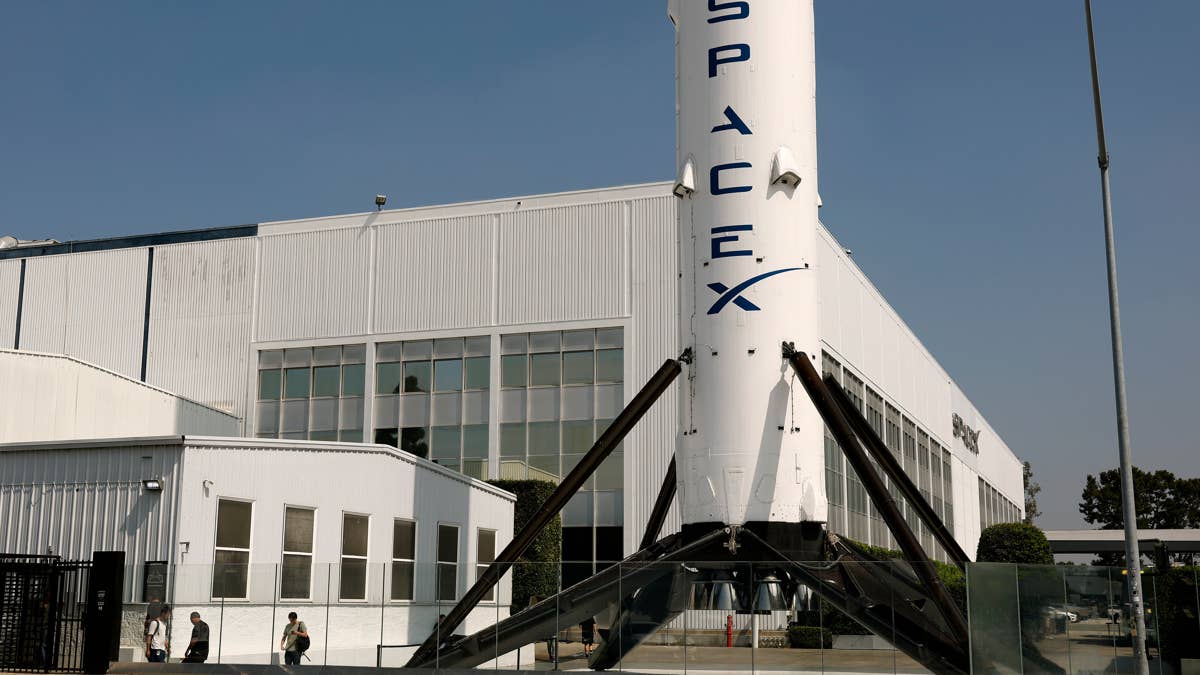 SpaceX said it wants Starlink to become a “major mobile carrier,” not just a satellite broadband provider.
Justin Sullivan / Getty Images
The phone bill is the prize
Starlink has built a big satellite internet business. But mainstream wireless is a different game.
Shotwell pointed to a U.S. wireless market worth about $600 billion a year. She predicted SpaceX would “acquire quite a few of their customers” because “our service will be better.”
Today, Starlink’s phone service runs on about 5 MHz through its T-Mobile partnership, as reported by TheStreet. Households are already paying plenty for the service they have. A 2024 J.D. Power study put the average wireless bill at $141 a month, down from $156 a year earlier.
SpaceX plans to sell Starlink mobile service straight to U.S. consumers. It is building on a satellite internet base of more than 10 million subscribers.
TD Cowen’s Gregory Williams has even floated the idea of SpaceX buying T-Mobile outright, calling it “the clear choice.” No bid has been made.
Key details are still missing. SpaceX expects its next-generation phone satellites to start launching in 2027, with full mobile service by the end of that year. But pricing, coverage maps, and device compatibility have not been made public.
Even T-Mobile’s T-Satellite service, which runs on Starlink, has drawn less usage than T-Mobile expected.
Carriers take a hit and push back
Investors did not wait for those details. Verizon, AT&T, and T-Mobile each fell between 6% and 8% in after-hours trading on Oct. 8. SpaceX shares gained ground, as reported by Yahoo Finance.
The selling deepened on Oct. 9, with all three carriers down by double digits at midday. Tower owners including Crown Castle moved the other way, rising after the agreement.
More Elon Musk:
- SpaceX CEO Elon Musk has 7 words for Delta Airlines after snub
- Elon Musk just handed Nvidia investors another big win
- Billionaire investor makes stunning $15 trillion Musk call
Morgan Stanley, JPMorgan, and Goldman Sachs were among more than a dozen banks to start coverage of SpaceX with buy-equivalent ratings that morning.
The incumbents are not buying the hype. AT&T CEO John Stankey dismissed SpaceX’s plan to put small cell stations at homes and businesses.
“If that were viable, we would be installing antennas on our massive fiber network,” he said. He argued such a network would cost roughly as much as a conventional one, according to TheStreet.
T-Mobile CEO Srini Gopalan made a similar case. He argued that satellite works best where towers are scarce, since one satellite’s bandwidth is shared by every user below it. He said of SpaceX, “It’s clearly not having a broad network.”
What investors should watch
Regulators come first. The FCC still has to approve the license transfer. The ground-network path requires SpaceX to serve at least a third of each license area’s population, or a quarter of its geography, by July 1, 2029. UBS analyst John Hodulik said the near-term hit to wireless fundamentals is limited.
The cost of the buildout is the next question. Bank of America sees Starlink as more likely to complement ground networks than replace them.
Matching T-Mobile’s outdoor coverage with small home cells could take anywhere from 500 million to 1.5 billion of them. At nearly $1,000 each, the equipment alone could run into the hundreds of billions of dollars.
Then comes the real test: customers. Bernstein’s Madison Rezaei sees a real but limited opportunity in rural, maritime, and disaster-response areas.
Musk’s ambitions may reach beyond Earth. But the next proof point is down here, in whether people actually switch.
Related: OpenAI makes development moves to counter SpaceX and Meta
