
Elon Musk wanted a flying car. A Chinese rival says he built a jumping one.
Deli Zhao, who leads XPeng’s flying-car affiliate, Aridge, said its two-seat aircraft could carry its first users in China as soon as next summer, the Guardian reported.
Speaking at the Web Summit in Lisbon on Nov. 10, Zhao said Tesla’s prototype was “really hopping or jumping and not really flying.” He agreed when asked whether Musk’s demo looked like a circus act, the Guardian said.
It’s the latest jab in a widening U.S.-China race over the vehicles of the future.
What Musk showed off in Texas
Musk unveiled a redesigned Tesla Roadster at a SpaceX test site in Texas on Oct. 15, ABC30 reported.
The driverless car climbed a steep ramp, hung upside down, flipped in the air, and landed using jets from 10 nozzles fed by “ultra high-pressure air tanks.”
Related: BYD just joined the fight over humanoid robots
“Success is not guaranteed,” Musk told the crowd. He said the car would enter production in 2028.
It’s impressive theater. But it isn’t a vehicle that cruises through the sky, which is Zhao’s point.
What $300,000 gets you from XPeng’s flying car unit
Aridge’s product takes a different approach. The company calls it the Land Aircraft Carrier.
You get a six-wheel van about the size of a Ford Transit. A flying module unfolds out of the back “just like the Transformers,” Zhao said.
The aircraft itself has no wheels. Six battery-powered propellers lift it, and the pilot steers with a joystick. It can also fly itself to a pre-programmed destination.
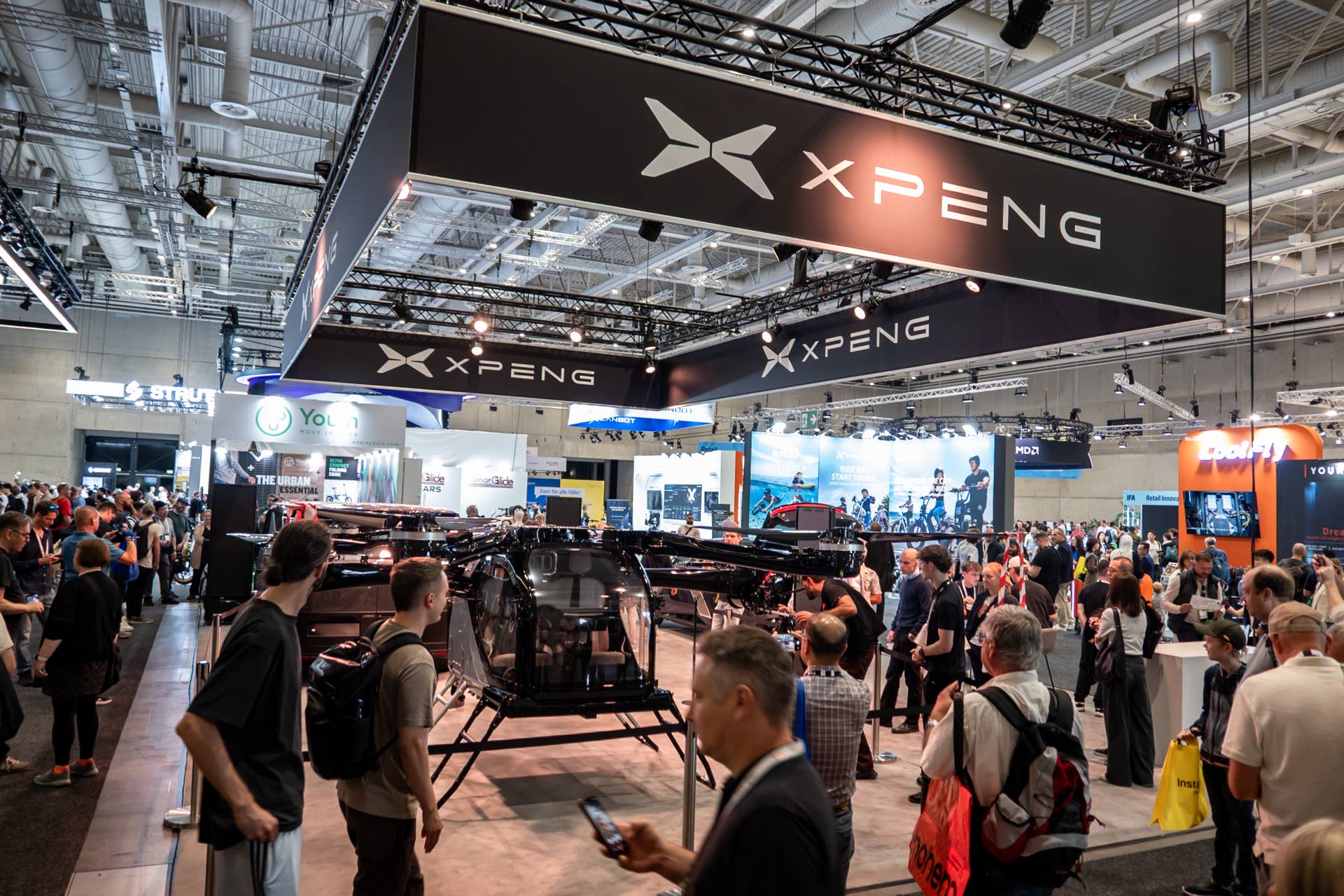 XPeng’s Aridge eyes 2027 for its $300,000 flying car and says Musk’s Roadster is “really hopping or jumping.”
Zhao, a trained pilot, claimed he could teach anyone to fly it in five minutes.
The whole package costs about $300,000, per the Guardian. That’s roughly what Aridge indicated last year, when a company spokesperson told the Global Times the price would come in under 2 million yuan, or about $281,000.
The aircraft can cruise as high as about 1 kilometer and has a flight range of 30 kilometers, or 18.6 miles. Zhao said a denser battery should soon double that range.
Where you could actually fly it
Don’t picture a commute over traffic just yet.
At first, the aircraft will only be allowed in approved park areas in China, plus emergency services that need to reach places that roads can’t reach, the Guardian reported.
More on Tesla and flying cars:
- Elon Musk doubles down on the Roadster with SpaceX thrusters
- Tesla investors hardly impressed with Elon Musk’s ‘flying car’
- Flying cars taking off into $1 trillion market
Zhao said the early buyers are people into “diving, surfing, off-roading and flying.” China’s civil aviation authorities have approved it for limited use.
That fits Beijing’s push into what it calls the “low-altitude economy.” That push starts with drones and cargo, then moves to passengers, and, over time, from rural areas to cities.
Zhao said Aridge is one of about 20 Chinese companies working on flying vehicles.
He also said it has signed agreements with the United Arab Emirates and countries in Southeast Asia. “We aim to enter the European market as soon as possible,” he said.
The timeline keeps sliding
Flying cars have a long history of missed dates, and this one is no exception.
A year ago, Aridge said it aimed to begin mass production and deliveries in 2026, the Global Times reported. Its Guangzhou plant was built for 5,000 aircraft a year at first, rising to 10,000.
In April, XPeng President Brian Gu told Reuters early deliveries could begin in late 2026, with full-scale delivery in 2027. He said the company had more than 7,000 orders, mostly from China.
Now the target for public use is the second half of 2027.
By my math, 7,000 orders at about $300,000 each would be worth roughly $2.1 billion. That assumes every reservation turns into a sale, which is far from certain.
At the plant’s starting pace of 5,000 a year, filling those orders would take about 17 months.
What it means for investors
XPeng shareholders shouldn’t expect flying cars to move earnings anytime soon. The company still makes its money selling electric cars, and the flying car business is a long-dated bet.
What Aridge has that Tesla doesn’t is a regulator’s sign-off for limited use and a factory ready to build. Tesla’s Roadster is still a 2028 promise.
For now, the race looks like this. China has a slow, expensive aircraft with real approvals. Musk has a spectacular stunt car and a production date that is still two years away.
