
Last holiday season, Starbucks customers lined up outside coffeehouses before sunrise, hoping to get their hands on a $29.95 glass cup shaped like a teddy bear.
Within hours, the coveted Bearista cup had disappeared from store shelves, leaving disappointed shoppers and sparking a booming resale market, with some sellers asking more than $1,000 for a single cup.
Starbucks apologized for the shortage, acknowledging that demand had exceeded its expectations.
A year later, the coffee giant has brought back its viral collectible. But this time, customers aren’t just paying more. They’re paying without knowing which bear they’ll get.
And the latest shopping frenzy suggests that last year’s chaos has become an even bigger opportunity for collectors and resellers.
Starbucks raises Bearista price and adds a sense of mystery
Starbucks launched its new Bearista Glass Cold Cup Surprise Box collection on Nov. 10 at select coffeehouses, with each box priced at $39.95.
That’s $10 more than the original $29.95 Bearista released in November 2025.
Unlike last year’s single design, the new collection features five hand-blown glass bears concealed inside mystery boxes.
Keeping up with the Christmas spirit, the characters include:
- Aspen, a skiing bear
- Reiny, a reindeer
- Joy, an ice-skating bear
- Bunny, a snow bunny that changes color with cold drinks
- Goldie, a rare golden bear
Starbucks describes Goldie as the “rarest Bearista of the bunch.”
However, the company has not disclosed how many Goldie cups were produced or the odds of finding one. So you cannot assume that you have a one-in-five chance of getting Goldie simply because there are five different designs.
Read more: Starbucks and Panera add a surprise to the holiday treasure hunt
Even spending $79.90 on two boxes doesn’t guarantee different bears, while buying five boxes would cost $199.75 before taxes without guaranteeing a complete collection.
As TheStreet previously reported, Starbucks attributed the higher price to additional design elements and accessories. An email to customers also indicated that returns and exchanges would not be allowed.
The company limited in-store purchases to two boxes per customer. Starbucks Rewards Reserve members received early online access on Nov. 9, with purchases limited to one box per member.
Starbucks Bearista cups are already reselling for hundreds
The latest release has once again attracted intense demand.
NBC Chicago reported that customers were lining up outside Chicago-area Starbucks locations early on Nov. 10. Reseller-focused website Resell Calendar reported that most stores sold out within minutes of opening, although the outlet did not provide a nationwide inventory count.
The secondary market was already responding.
More Retail:
- Struggling home goods chain closing more stores
- Verizon makes changes to be more like T-Mobile used to be
- Home Depot drops generous offers as customers grow harder to win
On Nov. 10, an eBay listing for Goldie was marked sold at $250, more than six times its original retail price.
However, resale prices vary considerably. Another Goldie listing was marked sold for $95 the same day.
Resell Calendar also reported that complete sets of the four other Bearista designs were fetching around $400, compared with a combined retail price of $159.80.
Those early transactions illustrate how quickly a collectible’s value can change, but they don’t establish what the cups will be worth once the initial excitement subsides.
The frenzy is familiar.
When Starbucks released its original Bearista on Nov. 6, 2025, the cup sold out in less than a day. Resale listings climbed toward $1,000, although those asking prices did not necessarily represent completed sales.
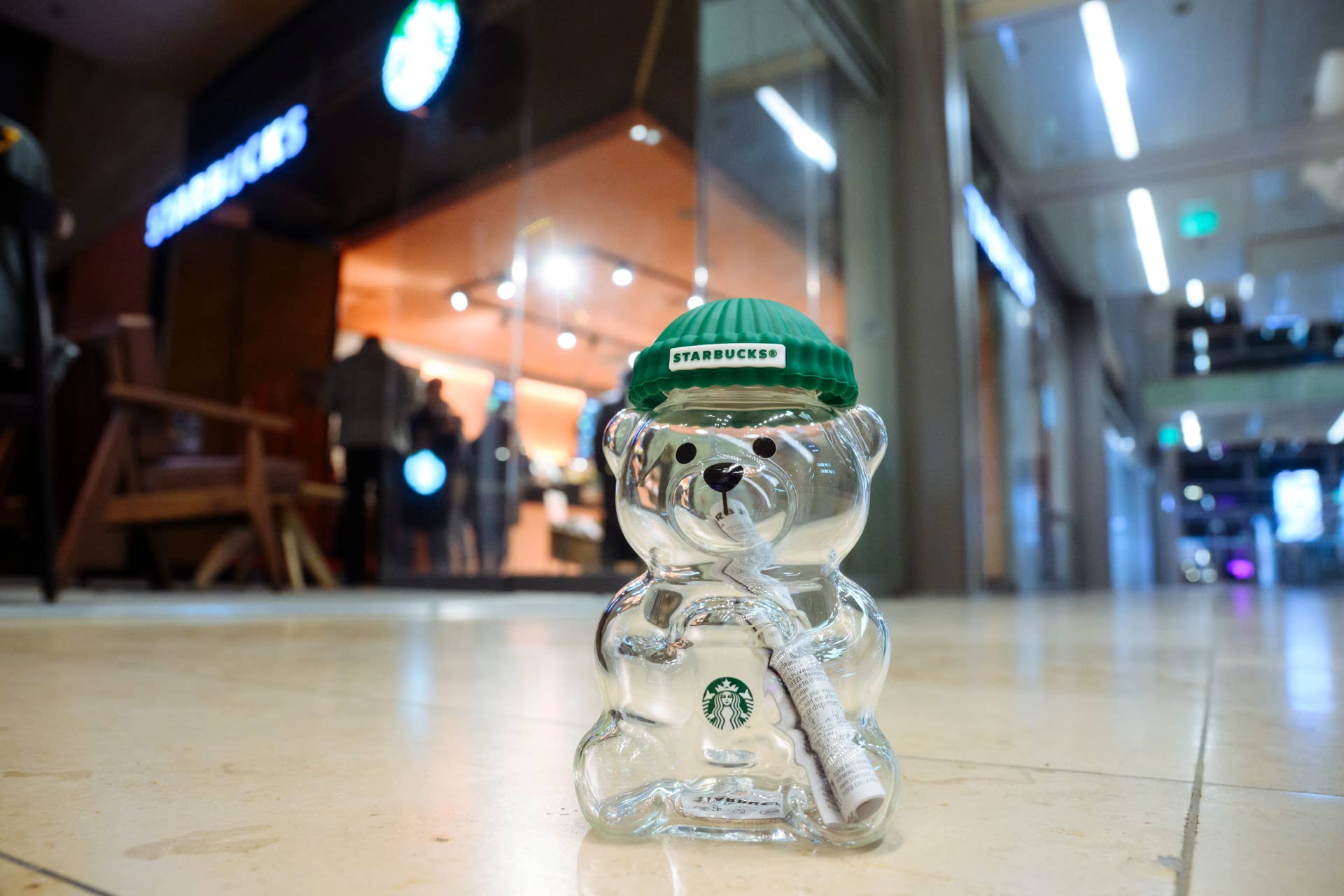 The resale market for Starbucks’ bear cup is already buzzing.
picture alliance / Getty Images
Rare Starbucks Goldie bear floods overseas resale market
The resale market is also raising questions about the availability and authenticity of Goldie, the rarest bear in Starbucks’ new collection.
While some U.S.-based sellers are asking hundreds of dollars for Goldie, sellers based in China and Hong Kong are advertising the collectible for considerably less.
One Hong Kong-based eBay listing offered Goldie for $50, plus $18 in shipping to the United States. On Nov. 11, the listing showed 34 units sold, including 31 sold that day, with another 37 available.
Another China-based eBay seller advertised the golden bear for $39.99, plus $15.99 in shipping, bringing the total to $55.98 before taxes. That listing showed 31 units sold, including 27 marked as sold that day.
The apparent availability is particularly striking because Starbucks describes Goldie as its rarest Bearista but has not disclosed how many were produced or the odds of receiving one.
The eBay sales counter this, while the product’s authenticity could not be independently verified. The listings do not establish whether the merchandise is genuine or how the sellers obtained their inventory.
For shoppers, the overseas listings present a dilemma: pay a significant markup to a domestic reseller or consider cheaper international offers with additional shipping costs and uncertainty about the products’ authenticity.
Starbucks sees a bigger opportunity beyond coffee
For Starbucks, the popularity of Bearista merchandise is becoming more than a seasonal phenomenon.
In a July 17 statement, Starbucks Global Chief Brand Officer Tressie Lieberman described last year’s Bearista launch as a turning point for the company’s merchandise business.
“That wasn’t just a successful product launch, it was an inflection point,” Lieberman said.
She explained that merchandise plays a critical role in the company’s Back to Starbucks strategy by extending the customer experience beyond coffeehouses. The company has since expanded the Bearista collection with additional designs, including the Pink Bearista, Soccer Bearista and Snoopy-themed glass cup.
Starbucks said the Pink Bearista collection had mostly sold out across North America by 7 a.m. on its July launch day.
“What started with a viral Bearista has become something much bigger,” Lieberman said.
The newest mystery-box format adds another incentive for collectors to keep purchasing merchandise, especially when a rare design cannot be selected directly.
But shoppers who simply want the original glass bear without the mystery will have another opportunity.
Starbucks has confirmed that its original green-hat Bearista cup will return on Dec. 1 at select coffeehouses, while supplies last.
The company has not announced a retail price for that returning design.
For anyone considering paying hundreds of dollars to a reseller, the December release provides another opportunity to purchase a Bearista directly from Starbucks, although availability will once again be limited.
Starbucks joins a growing blind-box shopping craze
Starbucks isn’t the only retailer turning an ordinary purchase into a guessing game.
Blind boxes, which conceal their contents until customers open them, have become an increasingly popular marketing strategy, particularly among younger shoppers drawn to collectibles, limited editions and surprise purchases.
According to The Harris Poll’s October 2026 report, 57% of Gen Z and millennials purchased a blind box or mystery box for themselves during the previous year, compared with just 16% of Gen X and baby boomers.
The trend has also helped fuel a broader collectibles boom.
According to Circana’s August 2026 report, U.S. toy sales increased by 17% during the first half of 2026, driven in part by strong demand for trading cards, collectibles, and licensed merchandise. Sales of toys purchased for adults aged 18 and older jumped 25%.
The trend extends beyond viral Labubu collectibles. Bookstores sell wrapped books through “Blind Date With a Book” promotions, while LEGO offers mystery boxes featuring characters from Spider-Man: Across the Spider-Verse.
Funko, a pop-culture company famous for bobbleheads, also sells Spider-Man Mystery Minis, with published odds for different characters, including certain rare figures at 1 in 72.
But there’s a psychological reason why retailers may find the strategy particularly attractive.
A January 2025 study published in the Journal of Retailing and Consumer Services examined how uncertainty influences American adults purchasing blind-box collectibles.
Through focus groups involving 31 consumers, researchers identified a recurring pattern in which the anticipation of opening a mystery package, the disappointment of receiving duplicates, and the desire to complete collections encouraged repeat purchases.
Some participants described the experience as addictive and compared the chance-based purchasing process to gambling. Researchers warned that the strategy, while effective at generating sales, could also create financial strain and negative perceptions of retailers.
With Starbucks’ new collection, customers are paying $39.95 per box without knowing which bear they will receive or the odds of finding the rarest one.
The mystery may be part of the appeal, but for shoppers chasing Goldie, each additional box is another $39.95 gamble with no guarantee of success.
