
Wall Street’s enthusiasm for artificial intelligence (AI) helped propel Nvidia NVDA to extraordinary heights. But lately, investors have been wondering if the AI boom has gone bust.
Concerns about the enormous costs associated with AI infrastructure and whether those investments will ultimately pay off have weighed heavily on technology stocks, with the Nasdaq falling 10% in November, erasing its 2026 gain.
Even Nvidia, whose powerful chips have become essential to the AI revolution, has been hit especially hard despite more than doubling its quarterly revenue.
The company also sent shockwaves through the market when longtime CEO Jensen Huang resigned amidst revelations of multiple extramarital affairs. He was, however, reinstated less than two weeks later, and Nvidia’s stock gained more than 30% in a single session as a result.
But while some investors are pushing the sell button on NVDA, others see an opportunity to buy shares at a discount.
Gene Munster, co-founder and managing partner at Deepwater Asset Management, is one of them.
Munster recently sat down with TheStreet’s Caroline Woods to explain why his firm has been buying Nvidia shares during the downturn, even though he acknowledges that he can’t identify a bottom.
He believes investors are allowing short-term fears to overshadow NVDA’s tremendous long-term potential, and that the company could be particularly well positioned to benefit as demand for AI computing power continues to grow.
His argument centers on three factors: continued demand for Nvidia’s powerful chips, the potential for recurring revenue as customers upgrade their equipment, and the possibility that the stock’s 45% selloff since October, prior to Huang’s reinstatement, created an attractive entry point.
Here’s what investors need to know before following his lead.
Note: The market musings expressed herein are those of the interviewed guest and should not be treated as professional investment advice. Readers should consult a certified financial planner (CFP) for individualized advice based on their available capital, goals, risk tolerance, and time horizon.
Why the AI sell-off could be a buying opportunity
There’s an important distinction between believing in AI’s long-term potential and believing that AI stocks will deliver strong returns in the near term.
Munster believes the recent sell-off reflects growing uncertainty about how much computing capacity companies will build and how they’ll pay for it, rather than a fundamental change in AI’s potential.
Those concerns extend beyond chipmakers like Nvidia. The amount of computing power available also determines what kinds of AI applications developers can build and how widely those services can be used.
But my sense is that the underlying fundamentals and separately how early we are are more powerful than what we’re seeing with the market psychology today. So I do not believe this is over. I believe that we are going to look at this window more broadly as a buying opportunity.
Gene Munster, when asked whether the AI trade is over
Munster believes that investor psychology can become self-reinforcing: Falling shares encourage people to assume that even more bad business news is coming, which can trigger additional selling. He also concedes that he underestimated how strongly investors would react to financing concerns and the possibility of political changes affecting data center development.
Still, he believes greater clarity about future spending could help restore investor confidence. After all, even disappointing financial forecasts can sometimes lift a stock if investors were expecting something worse.
Of course, that’s not guaranteed. A weaker-than-expected outlook could also signal that demand is deteriorating more than investors anticipated.
What could help Nvidia’s stock recover?
One factor Munster is watching closely is AI infrastructure spending.
Despite the stock’s steep recent decline, Nvidia’s latest financial results suggest that demand remains strong.
In its fiscal third-quarter earnings report, Nvidia reported revenue of $115.8 billion, an increase of 103% from a year earlier. Its data-center business, which supplies much of the computing power behind AI, generated $107.6 billion in revenue, which was up 110% year over year.
Nvidia also expects fourth-quarter revenue of approximately $130 billion. This suggests that the company anticipates demand for its products to remain strong.
But Munster wants more details from Nvidia and the other large cloud-computing companies, often called hyperscalers, about their plans to expand AI capacity.
These companies operate enormous computing networks and are among the biggest customers for the advanced chips used to train and run AI systems.
For investors, the questions are straightforward: How much more computing power do these companies need? How will they finance their expansion? And will demand for AI services justify the investment?
Munster believes that even a reduction in spending estimates could help stabilize the market if it removes some of the uncertainty.
After all, investors can evaluate a specific spending reduction more easily than an open-ended fear that companies might dramatically scale back their plans.
Cloud providers must ultimately earn enough from their AI services to justify their expenditures. And chipmakers like Nvidia must continue defending their market positions as competition intensifies.
Why Munster is buying Nvidia before the stock bottoms
So should investors buy Nvidia now or wait for the stock to fall further?
Munster isn’t trying to time the market.
He told Woods that Deepwater has been buying shares during the downturn, including Nvidia, even though some of those purchases have already declined in value.
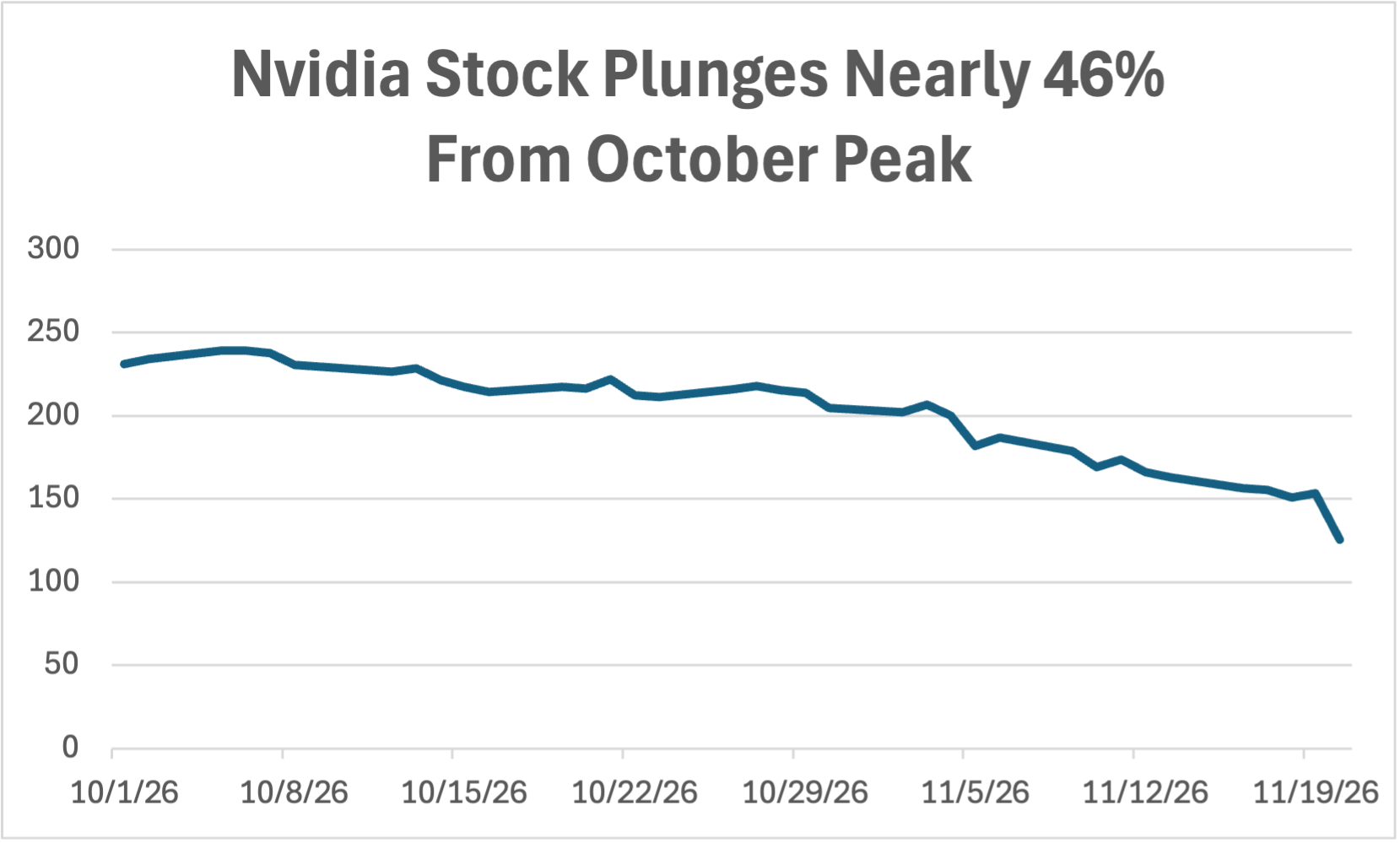
Yahoo! Finance
He remains comfortable with that decision because he believes the broader sell-off represents an opportunity for long-term investors.
Part of his confidence comes from firsthand experience using AI tools in Deepwater’s investment business.
Munster believes the technology is improving rapidly and could eventually help companies increase revenue, improve productivity, and expand profit margins.
But there’s a difference between recognizing the value of a technology and determining whether a particular stock is attractively priced.
Even an innovative company can be a disappointing investment if its shares already reflect overly optimistic expectations.
For investors considering Nvidia, the question is whether they’re prepared to withstand additional volatility while waiting for the company’s long-term growth potential to materialize.
Waiting for more financial results could reduce uncertainty, but it might also mean paying a higher price if investor sentiment improves.
Buying sooner offers the possibility of a lower entry price, along with the risk of further losses.
Why Nvidia’s chip upgrades could support its valuation
Nvidia is Munster’s preferred near-term AI stock, and his confidence goes beyond expectations for continued spending on AI infrastructure.
He also sees something that could make Nvidia’s business more predictable: recurring demand as customers replace older chips with newer, more powerful models.
That distinction could be especially important for Nvidia’s valuation.
Hardware businesses can fall out of favor when investors expect sales to surge during a period of heavy investment and then decline once customers have purchased the equipment they need.
But if customers regularly upgrade their chips, Nvidia could develop a more predictable stream of revenue instead of relying solely on waves of new infrastructure spending.
Munster draws an interesting comparison with Apple (AAPL) and the iPhone.
As the smartphone market matured, Apple continued generating revenue from customers replacing older devices with newer models.
Over time, Munster believes Nvidia could benefit from a similar replacement cycle as AI computing requirements become more demanding.
That doesn’t mean Nvidia deserves the same valuation as Apple, or that data-center chips and smartphones have identical purchasing patterns.
Cloud providers make equipment decisions based on performance, cost, and their infrastructure requirements. They’re also developing custom chips of their own, which could reduce their dependence on Nvidia.
Still, Munster believes Nvidia’s advanced graphics processing units (GPUs) will remain competitive, helping the company retain customers as AI technology evolves.
And if investors become more confident that Nvidia can generate recurring revenue from chip upgrades, they may be willing to assign its earnings a higher valuation multiple.
An earnings multiple compares a company’s share price with its earnings. Investors generally pay higher multiples for businesses they expect to deliver strong, sustainable profit growth.
However, even continued revenue growth wouldn’t necessarily prevent Nvidia shares from declining if investors become less willing to pay a premium for those earnings.
Munster hasn’t provided an exact price target for Nvidia. But he does favor Nvidia over Apple for the next 12 months, partly because he believes the market’s perception of Nvidia could improve.
Why Munster favors Nvidia over Micron
Nvidia isn’t the only semiconductor company positioned to benefit from growing AI demand.
Munster also sees potential in Micron Technology MU, which produces DRAM and high-bandwidth memory (HBM) chips used in AI applications.
He believes Micron shares could rebound, but reveals that Deepwater has been adding to its Nvidia position instead.
So why Nvidia over Micron?
Munster believes Nvidia has a stronger competitive advantage, which could help it defend its market position as competition intensifies. That doesn’t mean Micron can’t benefit from the AI boom, but he sees Nvidia as better positioned to protect its business over time.
Of course, a stronger competitive position doesn’t automatically make a company the better investment at every price.
Investors also need to consider valuation, earnings expectations, and the possibility that competition could erode profitability.
AI opportunities beyond Nvidia
Munster believes AI opportunities extend well beyond semiconductor companies.
He sees potential in businesses developing AI applications—software and services that put computing infrastructure to work.
He cites Snowflake SNOW and privately held Databricks as examples of companies he considers strong in that area. He says Deepwater holds Databricks through its private investment business.
Munster is particularly interested in personalized AI agents, which can perform tasks on behalf of individual users.
He points to Meta’s Muses as an example of how these tools could become much more widely used, although his expectations for adoption remain projections rather than established results.
He also sees potential in physical AI, which brings artificial intelligence into the real world through technologies such as autonomous vehicles, factory equipment, surgical systems, and humanoid robots.
As these applications develop, they could create additional demand for the computing infrastructure that companies like Nvidia provide.
However, widespread adoption doesn’t guarantee that every business involved will generate attractive profits.
Why Munster is more cautious about Microsoft and software stocks
Interestingly, Munster’s enthusiasm for AI doesn’t extend equally to every technology company.
He remains cautious about Microsoft MSFT and Adobe ADBE because he believes AI could fundamentally change how people interact with traditional software.
Many software products rely on interfaces that allow users to enter information, issue commands, and perform tasks.
But if AI agents increasingly communicate directly with other systems and complete those tasks automatically, some traditional software interfaces could become less valuable.
Munster even raises the possibility that businesses could eventually need fewer paid Microsoft user accounts as AI changes how employees work. However, he acknowledges that this potential disruption hasn’t yet appeared in Microsoft’s reported growth.
Established software companies also have valuable data, customer relationships, and other resources that could help them adapt to AI-driven changes.
Whether those advantages will offset potential pressure on their existing businesses remains an open question.
The distinction illustrates why Munster doesn’t view all AI-related stocks the same way.
He sees opportunities in companies developing new applications while remaining cautious about businesses whose existing products could be disrupted by the technology.
Is Nvidia stock a buy after the sell-off?
For investors considering Nvidia, Munster’s outlook offers reasons for optimism, but also some important questions to consider.
First, there’s demand.
Will chipmakers continue investing heavily in AI infrastructure, and will their customers regularly upgrade their Nvidia chips as newer, more powerful models become available?
Next, there’s competition.
Nvidia currently benefits from its position in advanced AI computing, but rival chipmakers and custom processors developed by its largest customers could threaten that advantage.
Then there’s valuation.
Even a company with strong revenue growth and impressive technology can disappoint investors if its stock price already reflects expectations that are difficult to meet.
Finally, there’s timing.
Munster is willing to buy Nvidia without knowing when the stock will bottom because he believes AI’s economic impact will unfold over many years.
But investors with shorter time horizons or less tolerance for volatility may prefer to wait for additional evidence that demand remains strong.
Munster himself acknowledges that he underestimated how quickly financing concerns and investor fears could drive share prices lower.
His optimism about Nvidia hasn’t changed, but the market has reminded investors that even the most promising technologies can experience painful sell-offs.
Whether Nvidia’s recent decline ultimately proves to be a buying opportunity will depend not just on the future of AI, but on the company’s ability to translate growing demand into sustainable earnings — and justify the price investors are willing to pay for them.
Some or all of this content may have been generated by AI. While we strive for accuracy, AI can occasionally produce incorrect information. If you buy something via one of our links, we may earn a commission.
