
Verizon sells customers a three-year “rate-locked” plan where its promise means absolutely nothing.
That’s because the phone company does not include its arbitrary fees as part of its rate lock offer.
It’s one thing to pass on taxes and other things the company does not control, but Verizon’s Administrative and Telco Recovery Charge rose from $3.78 to $4.69 per voice line on Nov. 15, and its Regulatory Charge went from $0.21 to $0.26 on Nov. 1, according to data from the company summarized by RSINC.
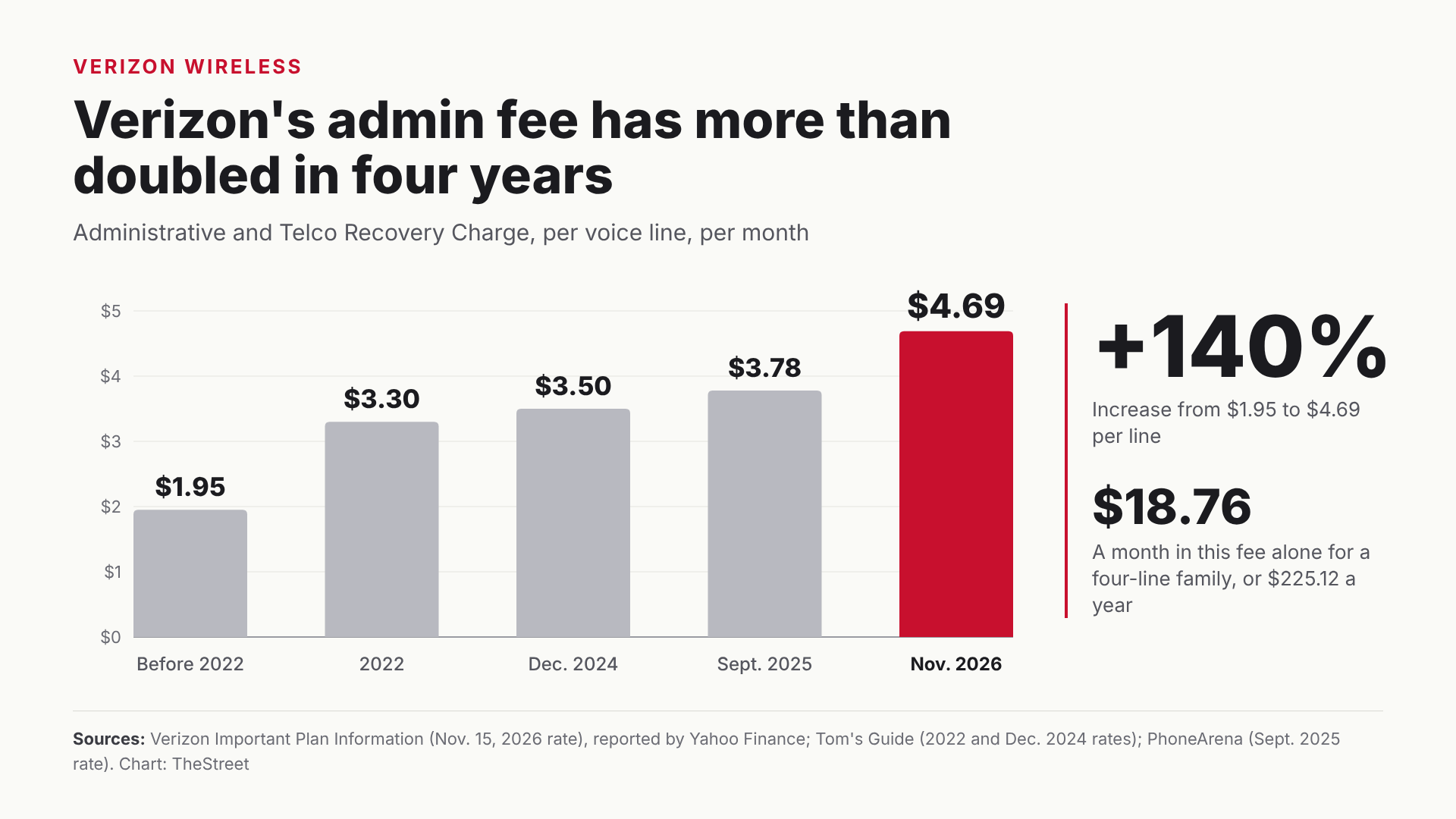
The fee, which survived a class action lawsuit, was $1.95 until 2022, then $3.30 in 2022, before rising to $3.50 in December 2024, then $3.78 in September 2025, with data-only lines jumping from $1.60 to $3.97, reported Phone Arena.
Now, it sits at $4.69.
That’s up 140% from $1.95. A four-line family now pays $18.76 a month in this one fee, or $225.12 a year.
And while Verizon sells customers a three-year rate-locked plan, that only covers the plan, not any random fees the company charges customers.
The latest increase went into effect on Nov. 15.
Verizon is hiding price increases in plain sight
On a web page explaining its various add-ons and fees, Verizon made it clear that the Administrative and Telco Recovery Charge helps the company defray and recover certain direct and indirect costs that it or its agents incur.
These include:
- Costs of complying with regulatory and industry obligations and programs, such as E911, wireless local number portability, and wireless tower mandate costs
- Property taxes
- Costs associated with our network, including facilities (e.g. leases), operations, maintenance and protection, and costs paid to other companies for network services
“These surcharges are Verizon charges, not taxes or government-imposed fees. These charges, including the amount and what’s included, are subject to change from time to time,” it shared.
More Verizon:
- Verizon makes changes to be more like T-Mobile used to be
- Verizon CEO lays out one condition for a Starlink partnership
- Verizon faces a concerning customer trend
Essentially, while offering rate-locked plans, Verizon has a backdoor through which it can pass on any expenses it wants to customers.
It’s a situation that renders the price lock irrelevant.
TheStreet
Verizon’s price promises aren’t real
“A three-year price lock sounds great, but what exactly are you locking in? Consumers hear that and assume their bill won’t go up for three years. Apparently, Verizon means only part of the bill,” RTM Nexus CEO Dominick Miserandino told TheStreet.
He understands why Verizon would pass on any taxes and fees, but that, Miserandino noted, isn’t what’s happening here.
“The bigger issue is that these aren’t all government taxes Verizon has no control over. Some are fees Verizon sets itself. If you can raise those fees while promising not to raise prices, you’re technically keeping your promise, but you’re certainly testing the customer’s definition of a price lock,” he added.
He sees the practice as dishonest.
“It’s a little like a restaurant promising not to raise menu prices, then tripling the service charge. The menu price hasn’t changed, but good luck explaining that to the customer paying the bill,” he added.
 Verizon can raise fees even after promising a rate lock.
Shutterstock
Billing issues push customers away
Recon Analytics analyzed 1.47 million U.S. consumer and business survey responses collected from Q3 2022 through Q4 2025 to quantify the billing experience gap.
“The findings are enlightening: billing issues drive customers wanting to churn at a 2.5x multiplier, and carriers with the oldest billing platforms are at an obvious disadvantage. Billing-related churn costs each of the three nationwide network operators north of a billion dollars annually,” the survey showed.
Verizon isn’t the biggest loser here, but it is lagging behind one rival.
“T-Mobile leads wireless bill clarity with a categorical Net Promoter Score of +17.7, a 10-point advantage over Verizon at +7.1, and a 12-point advantage over AT&T at +5.5. This gap has held steady across 14 consecutive quarters,” the Recon Analytics data showed.
Verizon is doing something that’s common in many industries. It’s advertising a price that doesn’t reflect the real cost.
It’s like visiting a hotel and leanring that there’s a resort fee you have to pay, even if you don’t plan to use the amenities.
It’s a deceptive practice that shouldn’t be legal. Verizon knows it’s doing something wrong, but also knows that most customers won’t go through the hassle of switching phone providers over a modest price increase, even when that increase isn’t so modest over time.
Related: Elon Musk edges closer to taking the T-Mobile and Verizon crown
