
Costco Wholesale is handing shareholders its biggest gift ever, but investors who have watched the warehouse giant’s special dividend history know the check usually arrives with a few strings.
The Issaquah, Washington-based retailer announced on November 10 that it would pay a $30-per-share special cash dividend — its sixth such payout and by far the largest in its history. The dividend is payable December 4 to shareholders of record as of November 24. Under T+1 settlement rules, the last day to buy and qualify was Monday, November 23 — anyone who purchased shares on the 24th (the ex-dividend date) or later will not receive the payment. Those who missed it can still collect the normal quarterly dividend, which came to $1.47 per share last quarter.
The total bill for the $30 special dividend: roughly $13.3 billion, nearly double the $6.7 billion Costco distributed in its previous special dividend of $15 per share in January 2024.
For shareholders, the math is simple. A holder of 100 shares collects $3,000 in a single payment. The $30-per-share payout also happens to cover nearly half the cost of a Costco Gold Star membership at current prices — a figure that underscores just how much cash the retailer has accumulated.
Alongside the dividend, Costco’s board reauthorized a $4 billion stock repurchase program through November 2030, replacing an existing $4 billion program adopted in 2023.
A fresh buyback plus a record cash payout reflects a company that generated more cash than it knew what to do with.
CFO Gary Millerchip foreshadowed exactly this dynamic on Costco’s second-quarter earnings call earlier this year.
“The great thing about our model is it generates significant free cash flow,” Millerchip told analysts, “and even with the investments we are making, we are seeing continued growth in that cash.”
He acknowledged at the time that a special dividend remained under board review and that cash levels had climbed back to pre-2024 payout levels. The November announcement confirmed the board acted on it.
It’s a tradition Costco’s former CFO Richard Galanti once described simply: “It’s part of our DNA,” Galanti said on a 2023 earnings call.
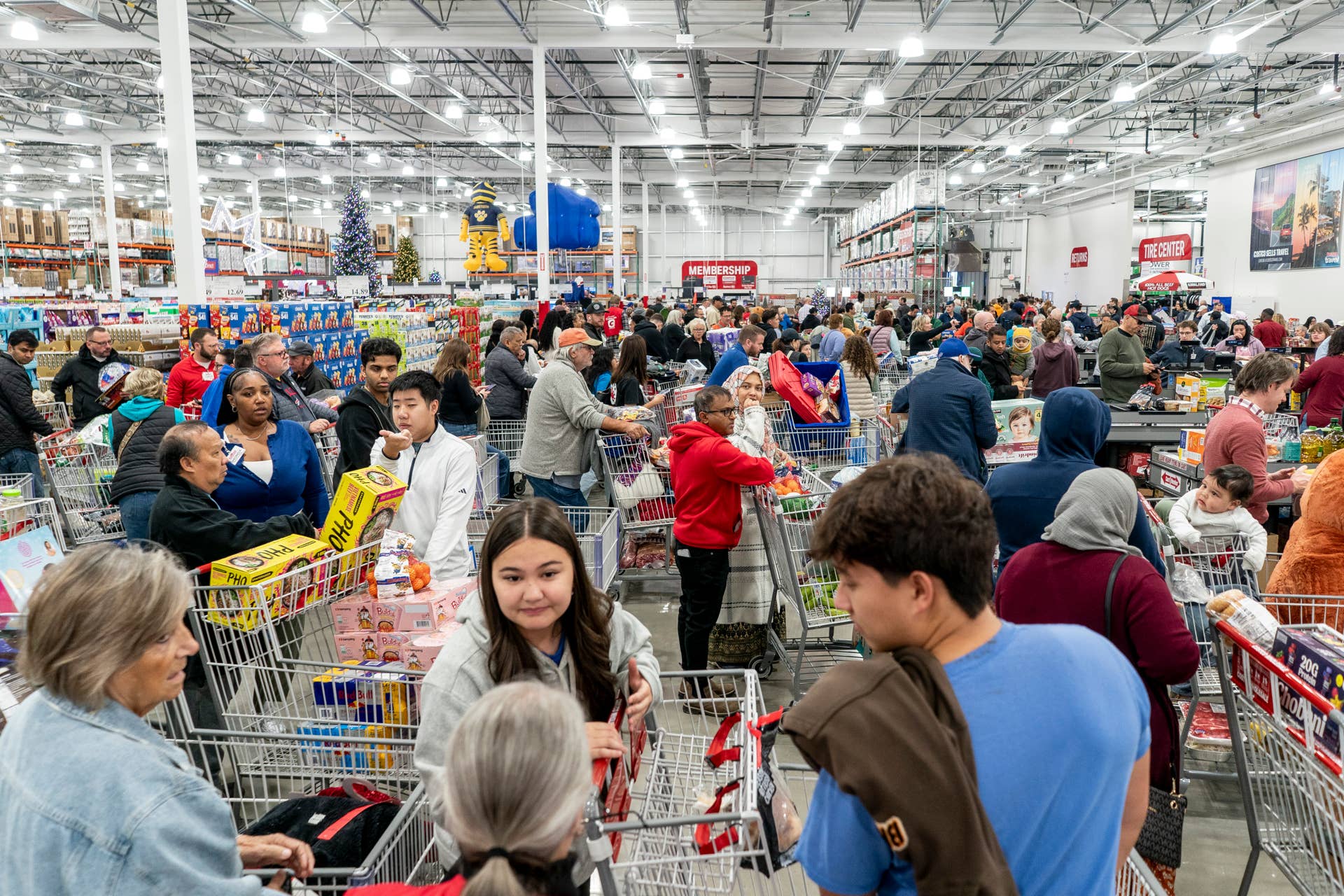 Costco is paying shareholders a $30 special dividend but you need to own shares before the close on November 24.
The Buffalo News / Getty Images
Costco’s full history of special dividends
The $30 payout is the latest installment in a pattern Costco has repeated five times since 2012, with each special consistently larger than the last.
Year
Amount per share
Approx. total payout
Paid
2012
$7.00
~$3.0B
December 2012
2015
$5.00
~$2.2B
February 2015
2017
$7.00
~$3.0B
May 2017
2020
$10.00
~$4.4B
December 2020
2024
$15.00
~$6.7B
January 2024
2026
$30.00
~$13.3B
December 2026
The progression tells its own story: Costco’s business has compounded at a remarkable clip, and management has consistently chosen to return surplus cash to shareholders in irregular lump sums rather than raise the regular quarterly dividend to levels that would create ongoing obligations. The $30 special is 2.0x the previous payout and 4.3x the 2012 original.
Also read: History of Costco: Company timeline and facts
One analysis cited in Costco coverage notes the payout is roughly two-thirds of the $20.2 billion in cash Costco held at the end of fiscal 2026 — a cash pile that grew by $6 billion in a single year.
What happens to Costco stock after a special dividend?
The honest answer: shares retreated early on, but in the longer term, Costco stock has recovered losses and moved to new highs.
On the ex-dividend date — the day shares trade without entitlement to the dividend — Costco stock has historically opened lower by roughly the dividend amount, as expected. The 2012 $7 payout produced an opening gap of approximately $7.51. The 2015 $5 payout opened about $6.42 lower. The 2017 $7 payout fell roughly $5.54 on the ex-date. This is standard market mechanics, not distress.
The three-month pattern after those early specials was less encouraging. Looking at the 2012 through 2017 payouts, the stock was lower on a three-month basis in most cases — down roughly 3% after the 2012 special, down more than 7% after the 2015 payout, and down nearly 13% in the three months following the 2017 dividend. That’s not a Costco-specific red flag; it reflects broader market conditions during those periods and the natural “selling the news” dynamic that follows a large one-time event.
Long-time fund manager Chris Versace is holding shares for the dividend, but is looking for an opportunity to sell some shares after the Nov. 24th record date.
“November 24 is the record date for Costco’s $30-per-share special dividend, and the shares have jumped considerably over the last few weeks. So even though tomorrow is likely to be a quiet day for the most part, don’t be surprised if, once trading starts, we elect to take some Costco chips off the table now that we’ve locked in that $30-per-share special dividend as of tonight’s close,” said Versace.
The 2020 special — a $10 payout during a period when Costco was printing money as a pandemic-era beneficiary — stands apart. The stock had already gained 29% year-to-date before the announcement. Shares fell 14.4% in the 3 months from the ex-dividend date of Dec. 1 through March 1.
The 2024 $15 payout, announced alongside a strong earnings report, came when shares were at all-time highs. More gains followed. Shares returned 11.66% between Dec 27, 2023 and Mar 27, 2024.
While the mechanics mean a smaller short-term share price, over time Costco stock has never failed to recover and reach new highs within roughly 12–18 months of any of its five previous special dividends. The three-month pullbacks are real but consistently followed by resumption of the underlying uptrend. Investors who sold after each special and waited to re-enter at lower prices generally underperformed those who held.
What the $30 payout signals about Costco’s business
A special dividend of this scale is a statement. Costco’s fiscal 2026 results showed net income of $2.998 billion in the fourth quarter alone, with comparable sales up 9.4% and digitally enabled sales growing 19.5%. Membership fee income reached $1.849 billion in the quarter, up 7.3% year over year, with 84.1 million total paid members at year-end.
CEO Ron Vachris described a business firing on all cylinders — from pharmacy growing nearly 20% to gas stations hitting record volumes to younger members under 40 now representing more than a quarter of the total base.
The timing of the dividend is deliberate. Paid in early December, the check reaches shareholders’ accounts in time for year-end portfolio reviews. Combined with the buyback reauthorization, this sends a clear message to institutional investors: management believes current cash levels exceed what any near-term capital deployment opportunity would justify.
Whether the $30 special marks a near-term top or a floor depends largely on factors beyond the dividend itself — consumer spending in 2027, the pace of international warehouse openings, and whether Costco’s membership model can sustain its renewal rates in an environment where household budgets remain stretched.
While Versace may trim shares, he remains confident that current trends support Costco.
“Consumers continue to be cautious and some are clearly struggling,” said Versace, noting that’s “positive” for Costco shares.
The history of five previous specials suggests that investors tend to overthink the event. Costco is paying you because it has the money. That’s rarely a reason to leave.
