
Health insurance shoppers are paying more and getting less this enrollment season. Jae Oh, CFP, is the author of Maximize Your Medicare and has written on the Affordable Care Act for advisors.
In a recent interview with me, he said the average premium increases being reported for ACA and employer plans understate what many households will actually pay, and that some employers are passing on costs by weakening coverage rather than raising premiums. With the federal marketplace deadline for Jan. 1 coverage coming up fast, the plan you pick now will set your health care costs for the coming year.
Below is a transcript of the interview with Oh, edited for brevity and clarity.
How much are ACA premiums really rising?
Bob Powell: Millions of people are signing up, or trying to sign up, for an Affordable Care Act plan or their employer’s health insurance right now. Is it fair to say it’s turmoil out there?
Jae Oh: It is. People are seeing statistics where 12% seems to be the average increase. I find that too low. In many locations, a silver plan is effectively higher than that: 15%. On top of that, deductibles are higher, and out-of-pocket maximums, while fairly stable, are also higher. We are seeing fewer plans at higher prices across the board.
Can catastrophic plans help healthy people save money?
Powell: Given all that, is there actionable advice, or is the outlook dim?
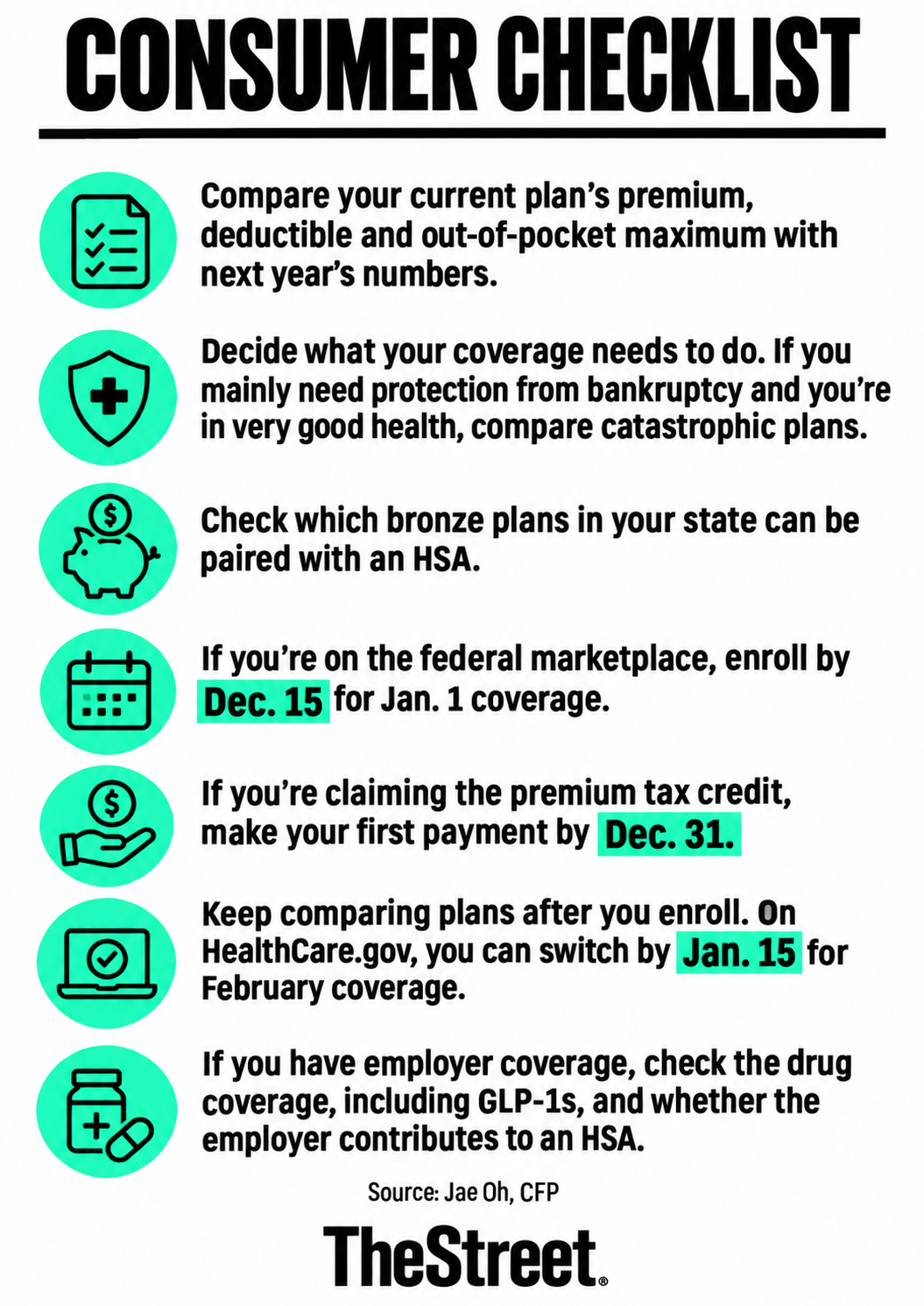
Oh: Not every outcome is negative. Some of the changes to the Affordable Care Act under the current administration have actually served some people well. Say you’re in very good health and you need health insurance mainly to avoid bankruptcy. If you understand that’s its role, you can find catastrophic plans. They seem to be more numerous and more affordable for many households.
How does a catastrophic health plan actually work?
Powell: How do catastrophic plans work, and what should people expect if they switch from, say, a silver plan?
Oh: It is strictly disaster insurance. That’s how I tell our clients nationwide to understand it. You’re responsible for all out-of-pocket costs up to a deductible, and in many cases that deductible is the same as the out-of-pocket maximum. Once you reach the out-of-pocket maximum, the plan pays the entire balance.
That helps right when you need it. When you’re facing very expensive hospitalizations and the stack of bills gets high, that’s when the value of a catastrophic plan kicks in.
What do bronze plans offer people who want an HSA?
Powell: Between silver and catastrophic, there’s a middle option people might consider.
Oh: Sure, bronze plans. You’ll need to check your state and the particular plan. But the number of ACA plans you can pair with a health savings account, or HSA, has certainly increased. An HSA is a special bank account. I describe it as a health-related IRA: an account where you can pay for your health care costs with pre-tax dollars.
When is the deadline to enroll for Jan. 1 coverage?
Powell: We’re recording this in late November. What’s the deadline to sign up for an ACA plan?
Oh: If you want insurance starting Jan. 1, the date is Dec. 15. If you’re claiming the premium tax credit, you need to make your first payment by Dec. 31.
One quick note: I’m talking about the federal marketplace. States that run their own Affordable Care Act exchanges can have very different deadlines and requirements, so check if you live in one of those states.
Can you switch ACA plans after you enroll?
Powell: If someone picks a plan now and later decides they want a different one, can they switch? Or is the first plan they pick the one they get?
Oh: You can switch, but you have to do it yourself. Say you enroll in plan No. 3 in your area, do some extra digging and find out plan No. 5 is best. You can change by Dec. 15 and have plan No. 5 in effect for January.
Beyond that, if you’re using HealthCare.gov, the last date to change plans for February coverage is Jan. 15. So procrastinators, or people who learn a new fact, can still change plans through Jan. 15 and have coverage in February. As it currently stands, that deadline will revert next year.
How much are employer health premiums really rising?
Powell: The other big group facing choices right now is employees in employer-sponsored plans. Lots of changes there, too?
Oh: A lot of changes. We’ll talk about Medicare separately, but retiree health plans for people who are retired and Medicare-eligible keep narrowing. For active employees, the national average increase is being reported as 6%. Again, I find that too low. In reality, we’re talking about the high single digits, maybe even the low double digits.
Employees may not see that increase directly. The employer may not have passed it along. Or the employer may have passed it along in a different form, by weakening the coverage. It’s a very peculiar combination, especially with GLP-1s. Coverage for a medication meant to improve the health of the working employee may become harder to get.
Should workers expect to pay a bigger share of premiums?
Powell: Historically, an employer might cover, say, 75% of the premium and the employee 25%. Are you seeing changes in that split?
Oh: Not at large employers. They have to balance against ACA rules on how much a large employer must cover. [EDITOR: verify; the ACA affordability test is based on the employee’s share relative to household income.] What you are seeing, and will continue to see, is small employers scrambling to find other configurations, because small-employer premiums continue to be very challenging.
How should you choose between PPO and HMO plans?
Powell: What about plan type: a PPO, an HMO or some other variation? Given the costs, what should people consider?
Oh: It very much depends. A blanket set of recommendations wouldn’t work, because large employers come in all shapes and sizes, and the plans they offer can vary a lot based on where individual employees live. When your menu is limited, the network is the primary concern in making your selection.
Should you pair a high-deductible plan with an HSA?
Powell: Some people can enroll in a high-deductible health plan and save in an HSA. Any advice?
Oh: In employer-sponsored plans, this trend continues, and it’s predictable. In some cases, to drive down the total health care benefit bill, employers are contributing to the HSA for employees who enroll and open one. If that option exists, you’ll want to match it.
Keep in mind that an HSA is very different from a health reimbursement arrangement, or HRA. The HSA is owned by the employee. It’s not a use-it-or-lose-it benefit.
Why does your income drive your ACA subsidy?
Powell: We covered a lot of ground. Anything we missed, or that bears repeating?
Oh: On the ACA, I’ve written a paper for the [VERIFY: institute name; transcript reads “Limmer Retirement Income Institute”]. While it’s aimed at advisors, the key point is that the premium tax credit for individuals is directly tied to your taxable income. [EDITOR: eligibility is based on modified adjusted gross income.] From there, all the financial planning implications come into play.
