
Your paycheck does more work than you might think.
It pays your rent and your grocery bill. It also funds the Social Security check you expect in retirement and the Medicare card you’ll carry at age 65, because every dollar you earn is taxed to pay for both.
For most of modern history, new technology changed the work people did without erasing the need for people to do it. Farmhands became factory workers. Bank tellers learned to sell mortgages after the ATM arrived. Typists became office managers when the personal computer landed on every desk.
Each shift was painful for the people caught in it, but the tax system kept working because people continued to earn paychecks. Washington never had to ask whether a machine should pay into Social Security.
That question is now on the table, and one of the most famous names in tech is the one asking it on national television.
On Oct. 11, Microsoft (MSFT) co-founder Bill Gates told Jake Tapper on CNN’s “State of the Union” that AI “changes the world more than all previous technologies.” He called the personal computer and the internet “a big deal, but nothing compared to this.”
Then he went further than most tech leaders are willing to go.
Gates said the country may need to protect certain jobs from automation entirely. “The idea that you need to reserve things for humans may sound bizarre, but, in fact, we will get there,” he said.
Gates wants a decision on taxing AI and robots
The Microsoft co-founder framed the job question as a choice the country can’t avoid.
“We really do need to make a decision as a society, how do we tax AI usage or robot usage?” Gates asked. “Where do we want to make sure the human jobs are preserved?”
He pointed to “how fast these models are improving and what the incentive is to use the AI in place of human labor.”
Gates has floated the idea before, and he is pushing it harder now.
In an August essay on his GatesNotes blog, he argued for taxing both robots and AI tokens, the units of data that AI systems process, because the current tax code can reward companies for replacing workers.
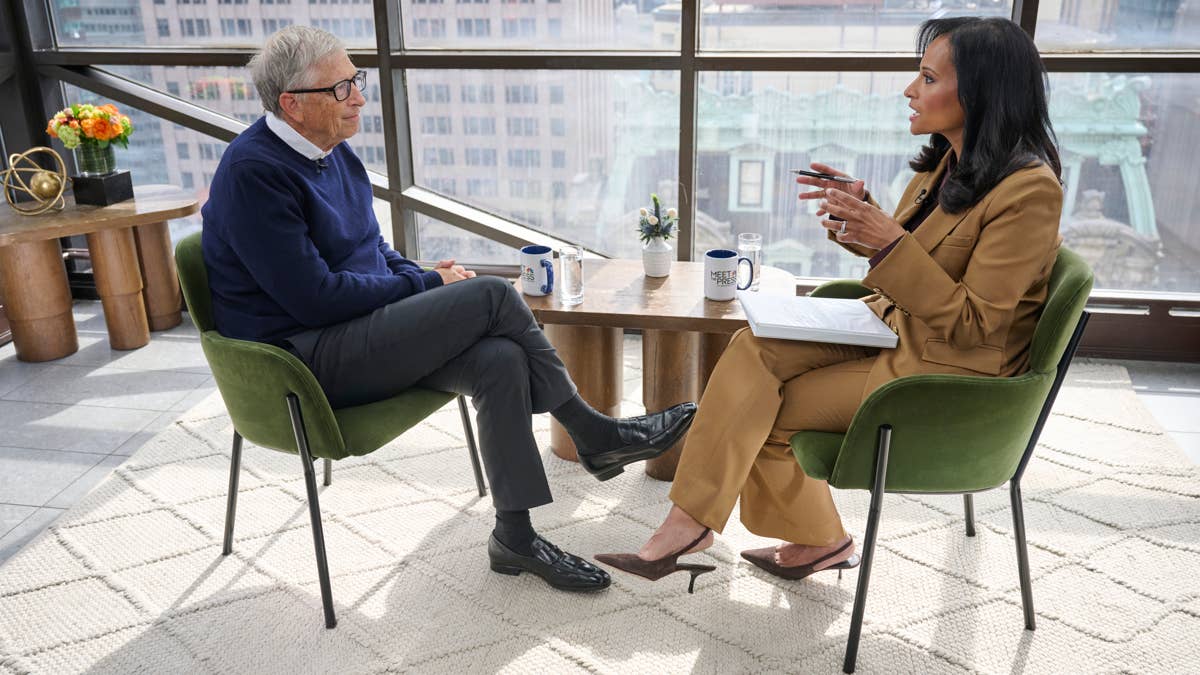 Bill Gates says society needs to decide how we tax AI usage or robot usage.
Why the payroll tax math matters to your retirement
In my analysis, this is the part of Gates’ argument that lands closest to your wallet. When you earn a paycheck, you pay 6.2% for Social Security and 1.45% for Medicare, and your employer matches both.
I ran the numbers on a $60,000 salary. That one job sends about $9,180 a year in combined payroll taxes to the two programs. If an AI system takes over that work, the company’s costs fall, but none of that $9,180 gets paid.
Related: AI Could Blow a Hole in the Federal Budget
That gap is critical because Social Security’s main retirement fund is already under strain. The program’s trustees projected in June that the fund will run dry in the fourth quarter of 2032, after which incoming taxes would cover only about 78% of scheduled benefits.
Fewer human paychecks would mean fewer dollars flowing in to close that gap. That’s the practical case behind Gates’ tax question, whatever you think of his answer.
Layoffs tied to AI are already running high
The job losses Gates is talking about are no longer theoretical. Challenger, Gray, & Christmas, the outplacement firm that tracks announced layoffs, has counted AI among the leading reasons employers give for cuts this year.
Here is what its October report shows for 2026 through September:
- Employers announced 573,195 job cuts in total.
- They attributed 120,136 of those cuts to AI, about 21% of the total.
- In September alone, AI accounted for 3,961 of 43,281 announced cuts.
Through May, AI-linked cuts had already passed the 54,836 recorded for all of 2025, Challenger said at the time. “The labor market is being reshaped by technology in real time,” Andy Challenger said then.
A one-year clock on AI self-regulation
Gates also took aim at how AI is policed today. He predicted that “over the next year, we will move beyond self-governance,” meaning AI companies would no longer set their own safety rules.
CNN’s “State of the Union” also shared a clip in which Gates warned of “grim possibilities if we don’t maintain control” of AI. “It’s clear we’re not doing enough,” he said.
More Artificial Intelligence:
- Trump’s ‘Super Intelligence’ order rolls through the tech world. But will it last?
- Meta Muse gives AMD and Intel investors a reason to cheer
- Microsoft’s $665 target hinges on a new AI advantage
In a statement that CNN’s “State of the Union” posted on X, Gates compared AI to industries the government already oversees, Benzinga noted. “Just as we regulate planes, cars, and medicines, we need safeguards that help us realize AI’s incredible potential while reducing the risks,” he said.
That puts him at odds with the White House. After a Sept. 29 lunch with AI executives, President Donald Trump said “self-regulation is very important” and that the companies “understand that they have to self-police,” Moneywise reported.
Gates has said he hopes to discuss his concerns with the president and “his key people.” Two weeks earlier, he told NBC’s “Meet the Press” that AI is “certainly powerful enough to drive events that, you know, cause a billion deaths.”
What you can do while the AI safety rules get written
You can’t set tax policy, but you can make your own income harder to automate. Start with the tasks in your job that require judgment, trust or in-person work, and build skills there.
Keep an emergency fund that covers several months of expenses. If AI-driven layoffs keep running at this pace, a cushion buys you time to retrain instead of grabbing the first offer.
Check your Social Security statement at ssa.gov once a year so you know what you’ve earned so far. If the trust fund math changes, you’ll want to plan with real numbers.
Gates is betting that Washington will pick a side within a year. Your best move is to be ready whichever way it goes.
Related: ‘Big Short’ investors split over the AI risk that matters most
