
Every February, millions of Americans open TurboTax, type their W-2s, and hope the refund beats last year’s. It is one of the most familiar rituals in personal finance.
It is also the part of Intuit (INTU) that Wall Street worries about most right now.
CEO Sasan Goodarzi tried to steady nerves on Nov. 19. “We delivered a solid first quarter, with results above the top end of our guidance,” he said in a company statement. An unexpected twist unrelated to taxes also emerged, as TheStreet previously reported.
Intuit agreed to sell Mailchimp, its email marketing platform, to Bending Spoons. That is the Milan-based serial acquirer I wrote about recently, when Berkshire Hathaway disclosed its stake.
On Nov. 17, in a note shared with me at TheStreet, Morgan Stanley told investors that, before the print, several big questions would remain open. So how did the answers hold up?
Also Read: TurboTax parent’s $12 billion bet ends with a costly twist
Why Intuit is selling Mailchimp to Bending Spoons
The deal is worth about $3.68 billion. Of that, $3.31 billion is cash and $368 million is Bending Spoons stock. It is expected to close in early calendar 2027, pending regulatory approvals.
Mailchimp generated $313 million in revenue in the quarter, down 1%. By my math, the price is roughly three times annualized revenue for a business that is not growing.
More Tech:
- Apple CEO signals surprising change for iPhone users
- Comcast sends wake-up call to employees as customers cut services
- AI agents’ growing role in payments raises an awkward question
Intuit plans to use the cash proceeds to buy back its own shares within fiscal 2027 after the deal closes, according to the company. The company already bought back $1.5 billion of stock in the first quarter, up 73% from a year earlier, and has $6.4 billion of authorization left.
Goodarzi said the sale “sharpens Intuit’s focus” on AI-native tools for small businesses. That is a tidy way to say Intuit would rather put its energy where growth is.
Bending Spoons sees more than a software acquisition
I spoke with Joe Hyrkin, a CEO coach and former Issuu CEO who sold the publishing platform to Bending Spoons in 2024, about what the Mailchimp acquisition could mean. He believes Bending Spoons is building something much bigger than a collection of acquired software companies.
Intuit originally paid about $12 billion for Mailchimp five years ago. Now, it is accepting roughly $368 million in Bending Spoons equity as part of the sale.
Also read: Nvidia stock soars 30% after brutal selloff as Jensen Huang returns
That is a vote of confidence in the buyer, much like Berkshire Hathaway‘s earlier $689 million investment in Bending Spoons.
The market may focus on the steep difference between Mailchimp’s original purchase price and its latest sale valuation. But Bending Spoons is betting on something bigger than owning another software company.
Its shared operating platform and growing portfolio could create distribution opportunities, allowing customers of one acquired business to discover and use another.
If it executes, that could make the individual businesses more valuable together than they are separately.
The Credit Karma cut that complicates the story
Not everything in the fiscal 2027 first-quarter report was as clean, though. Intuit lowered its full-year revenue guidance to $23.08 billion to $23.37 billion, from $23.28 billion to $23.51 billion.
That implies 8% to 9% growth, down from 9% to 10%.
The reason is Credit Karma. Management cut its growth outlook to 3% to 7% from 11% to 13%, citing interest-rate pressure and consumers shifting toward AI search tools. Consumer segment growth for the year now stands at 2% to 4%.
Related: Walmart’s CEO shares big news for time-strapped grocery shoppers
Think about how you shop for a credit card or loan today. Many people now ask a chatbot first. That habit is quietly changing where Credit Karma’s traffic comes from.
In the second quarter, Intuit expects the Consumer segment to decline at a mid-single-digit rate. Profit guidance did not move. Non-GAAP earnings per share (EPS) of $22.88 to $23.12 was reaffirmed.
What went right in the first quarter
The headline numbers were solid, according to Intuit:
- Total revenue rose 12% to $4.4 billion.
- Global Business Solutions revenue rose 15% to $3.1 billion.
- QuickBooks Online Accounting revenue rose 19% to $1.4 billion.
- Non-GAAP EPS rose 56% to $2.91.
- TurboTax revenue rose just 1% to $199 million.
The board also approved a quarterly dividend of $1.38 per share, up 15% from a year ago, according to the company. Small business is carrying the load. Consumer is where the questions live.
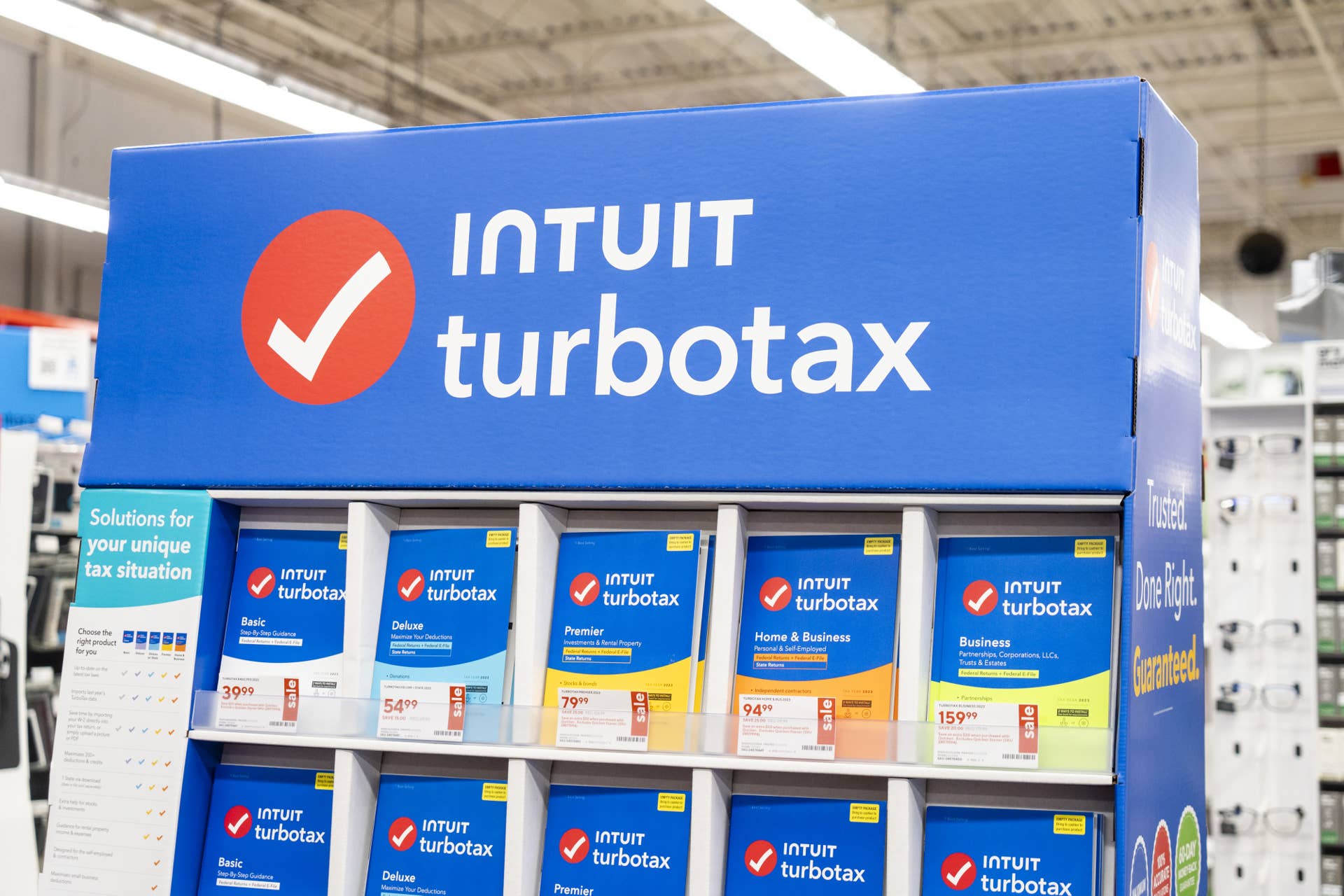 Morgan Stanley worried that Intuit’s move to TurboTax’s lower-priced options for do-it-yourself filers is “significant and unproven.”
How Morgan Stanley framed the setup
Morgan Stanley rates Intuit Equal-weight with a $315 price target, according to a note shared with TheStreet. The firm flagged three questions before the report: TurboTax’s pricing reset, softness in small business, and how long margin gains can last.
On TurboTax, the firm worried that Intuit’s move to lower-priced options for do-it-yourself filers is “significant and unproven.” Management’s guidance implies do-it-yourself revenue will fall in the low-to-mid teens, the note said.
Related: Major exchange unveils AI platform that could change trading forever
On the bright side, Intuit Enterprise Suite has reached $146 million in annual recurring revenue (ARR) in two years. Morgan Stanley noted that AI-native ERP startups combined are likely near $30 million. Even so, new $20-a-month plans such as QuickBooks Lite may limit how much that helps estimates in the near term.
The firm’s valuation scenarios range from $205 in a bear case to $380 in a bull case. The stock trades at about 14x calendar 2027 earnings, the note said. It has beaten the median software stock by more than 15% in the past month but lags it by more than 50% year to date.
Morgan Stanley’s most important line is that it sees “limited scope for clarity before the 2027 tax season.”
My take on what happens next
I think the Mailchimp sale is a smart, unglamorous decision. It trims a slow business, funds buybacks, and lets management tell one story instead of three. A slowing macro environment negatively impacts the more macro-sensitive businesses of Credit Karma and Mailchimp.
But the Credit Karma cut suggests Morgan Stanley’s caution was justified. Intuit is changing prices, products, and traffic sources at once, and no single quarter settles that.
The real test comes in the spring when millions of people sit down to file their 2027 tax returns. We will find out whether cheaper TurboTax options bring more people in or earn less per customer. Until then, the stock is likely to trade on hope and buybacks.
For Bending Spoons, however, the opportunity extends beyond buying Mailchimp at a lower valuation than Intuit originally paid.
The company is building an operating platform to make each acquisition more efficient, and a distribution platform that could make each business more valuable through its wider portfolio.
More Stocks News
- Verizon and AT&T may have a bigger Elon Musk problem than expected
- Gap puts one of its four chains under “comprehensive review”
- GTA 6 broke every record, and Take-Two’s real test starts now
- He correctly said the S&P 500 would fall to 7100; Now, Morgan Stanley’s Mike Wilson has another gutsy forecast
