
For a few hours on Nov. 12, Wall Street got a look at what it might cost Nvidia to lose the man who’s effectively been the face of the AI boom.
Nvidia stock tanked as much as 14% after the company announced Jensen Huang’s resignation on Nov. 12. It recovered much of that drop, only to fall again the next day.
By the end of the week, Nvidia stock (NVDA) changed hands for $162.85, down over 6% across the two sessions, a loss of roughly $260 billion in market value.
The Nasdaq dropped 0.4% on Nov. 12, so Nvidia stock basically bore the brunt of it.
Veteran analyst and “Mad Money” host Jim Cramer backed CFO Colette Kress as interim CEO. Then, in a post on X a day later, he called Huang “irreplaceable.”
At first, those takes sound as if they belong to two different people. But Cramer was answering two different questions: Who can keep Nvidia moving next week, and who gets to decide where it goes next?
Cramer’s warning is about how Nvidia makes decisions
“The biggest problem with finding a new CEO for Nvidia is that Jensen made himself irreplaceable with that structure and his free form nature,” Cramer wrote on X on Nov. 13.
Perhaps the word I’d focus on the most is “structure.”
“I don’t do one-on-ones, and my staff is quite large. Almost everything that I say, I say to everybody all at the same time,” Huang said in a 2024 Stripe Sessions fireside chat with Stripe CEO Patrick Collison.
More Nvidia:
- Microsoft just gave Nvidia shareholders a reason to pay attention
- Nvidia has a stake in SpaceX that came from an unexpected place
- Nvidia’s $12.9 billion deal could shape the AI apps you use
That style is similar to what Steve Jobs did with Apple, saying at the D10 conference that the company was “organized like a start-up.” He described putting individual leaders in charge of areas such as iPhone software and Mac hardware, then bringing them together weekly to discuss the whole business.
For Nvidia, that meant engineers working on multiple pieces of the same system could hear the trade-offs firsthand. However, a flat organization can still depend heavily on one person. When chip designers, software teams, and customers want different things, who decides what ships first?
That’s exactly the part of Huang’s job that doesn’t transfer with the title.
That said, on the day the transition was announced, Cramer said Kress would “provide some needed order,” according to Benzinga. He later described her as one of the more rigorous, intense, and tough people he’s met in his life.
For now, Kress will remain CFO and steer the company while the board searches for a permanent CEO.
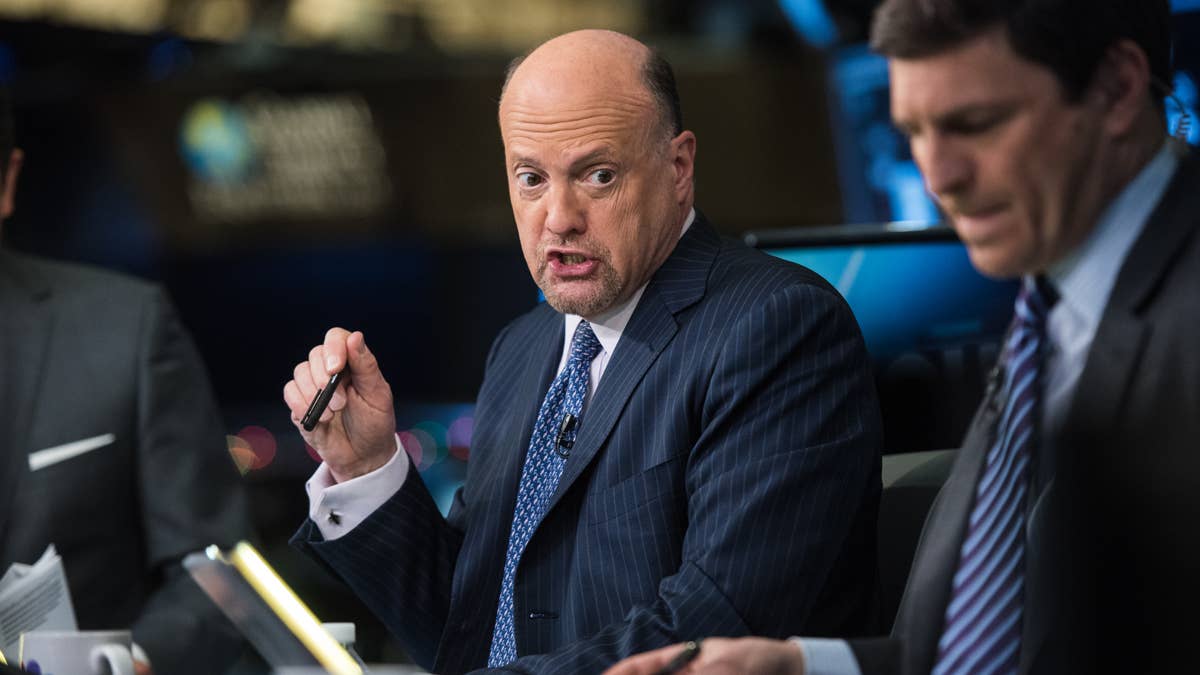 Jim Cramer backs interim CEO Colette Kress but calls Jensen Huang “irreplaceable.”
Why Stephanie Link sold a business she still likes
On CNBC’s Power Lunch on Nov. 13, Hightower Advisors’ Stephanie Link argued that Nvidia’s “fundamentals are incredible.”
However, despite the robust fundamentals, she’s still selling.
The fallout was “just gonna dominate the headlines for the next many months.” She saw a risk that the shares would go nowhere for months, even if the business continued dishing out a ton of cash flow.
Instead, like many investors, she bet more money on Micron instead of walking away from the AI trade altogether.
For context, Nvidia’s last reported quarter showed sales of $96.2 billion, up 106% year over year, with data-center sales up 117% to $89 billion. Those lofty figures explain why someone would buy the dip.
However, they don’t answer whether investors will pay the same price for each dollar of earnings while the board searches for a CEO and an independent investigation remains unresolved.
Nvidia stock looks cheaper: Here’s what would make it a bargain
At its most recent closing price, Nvidia traded at around 17.5 times forward earnings, which is 58% lower than its 5-year average, according to Seeking Alpha. In terms of sales, it’s trading even cheaper at around 9.5 times forward estimates.
Those multiples depend heavily on how the future shapes up. For instance, if expected profits drop by 20%, the same share price would be closer to 21.8 times. The stock wouldn’t need to rise a penny to become far more expensive on that measure.
For Nvidia, the first big test arrives on Nov. 17.
Its prior guidance called for $108 billion in quarterly revenue and a 74% gross margin at the midpoints, without assuming any data-center compute revenue from China. However, for me, all eyes will be on what Kress says about the next quarter.
Are customers sticking to their Vera Rubin deployment schedules? Are margins holding as shipments ramp? And will Nvidia disclose any new restrictions or customer changes that would affect future sales?
For now, the company says it expects operations and customer commitments to continue without interruption. The call is a chance to see what that looks like in orders, shipments, and guidance and have a better understanding of where things go from here.
Related: Intel CEO’s warning offers a 2027 signal for Micron investors
