The hardest part of investing is usually sitting still. Every headline invites you to do something, and every trade feels like progress.
Wall Street has a long list of sayings meant to talk you out of that itch. Few have stuck to one stock as tightly as Jim Cramer’s line about Apple (AAPL).
The CNBC host has repeated it for years, through product flops, CEO changes and tariff scares. He said it again in April on Mad Money, ahead of Apple’s earnings and Tim Cook’s handoff to John Ternus.
“I say own it, don’t trade it,” Cramer said, according to an Insider Monkey recap published on Yahoo Finance. The phrase made the rounds on X again on Friday, Oct. 16, the same morning Apple’s first foldable phone sold out in minutes.
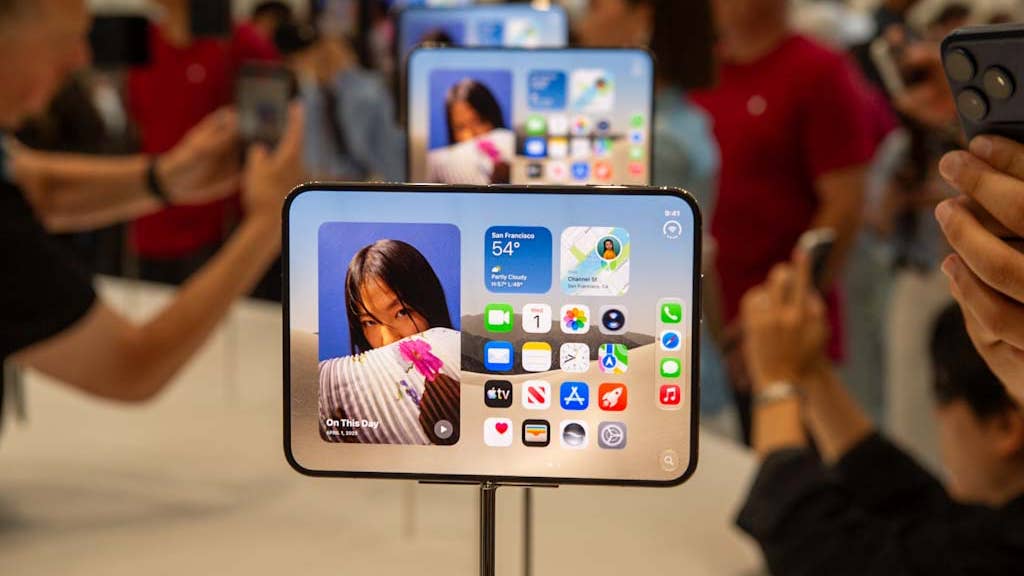 Cramer’s “own it, don’t trade it” mantra resurfaced Oct. 16 as $1,999 iPhone Duo preorders sold out.
picture alliance / Getty Images
Cramer’s buy-and-hold rule, explained
The idea is simple. You buy a company you believe in and hold it through pullbacks instead of trying to time every bounce.
Cramer has said Apple and Nvidia (NVDA) are the only two stocks that earn that top label from him, 24/7 Wall St. reported. He has also called the iPhone Duo “kind of astounding.”
Not everyone takes his calls at face value. Social media users have long joked about doing the opposite of Cramer’s picks, a trend known as “inverse Cramer,” as Benzinga has reported.
Apple shares sit near a 52-week high
Apple heads into its fiscal fourth-quarter report with momentum. Here’s where things stood, according to company results and market data:
- Apple closed at $343.46 on Oct. 16, up 0.43%, with a 52-week range of $243.42 to $348.15, The Motley Fool reported.
- iPhone Duo preorders sold out within minutes, and delivery estimates slipped from Oct. 23 to late January, the same report said.
- Fiscal third-quarter revenue rose 16% to $109.4 billion, with iPhone sales up 22% to $54.3 billion, according to figures compiled by 24/7 Wall St.
- Apple authorized a $100 billion stock buyback on April 30, 24/7 Wall St. reported.
In my view, the Duo sellout is exactly the kind of headline that tempts people to trade. A sold-out launch can lift a stock before earnings, then fade if the next quarter’s guidance disappoints.
Related: Jim Cramer’s net worth: How much does ‘Mad Money’s’ stock-picking superhost make?
Holding instead of trading can cut your tax bill
Here’s where Cramer’s line turns into dollars. The IRS treats gains differently depending on how long you hold.
Sell a stock you’ve owned for a year or less, and the profit is a short-term gain taxed at your ordinary income rate. Hold it for more than a year, and most middle-income investors pay a long-term rate of 15%.
Say you make a $10,000 profit on Apple shares and you’re in the 24% federal bracket. Here’s how the two paths compare:
- Trade it inside a year: about $2,400 in federal tax, leaving you $7,600.
- Hold it past one year: about $1,500 in federal tax, leaving you $8,500.
That’s $900 more in your pocket for doing nothing but waiting. Trade in and out a few times a year, and the gap can compound against you.
This is general math, not personalized tax advice. State taxes, the net investment income tax and your exact bracket can change the numbers, so check with a tax professional before you sell.
Single-stock risk doesn’t disappear
Owning one company, even a great one, concentrates your risk. Apple dropped from about $340 to roughly $309 after its July earnings, 24/7 Wall St. reported, a reminder that long-term holders still ride out sharp swings.
I’d treat “own it, don’t trade it” as a rule about behavior, not a guarantee about returns. It works best when Apple is one position inside a diversified portfolio, not the whole plan.
Earnings on Nov. 2 are the next test
Apple reports results on Monday, Nov. 2, according to The Motley Fool. Investors will want to see how much of the Duo demand Apple can actually ship before the holidays, and whether the late-January delivery window shows up in guidance.
If you already own Apple, the earnings report is a reason to listen, not a reason to sell. If you don’t, a sold-out phone is not a buy signal by itself.
Cramer’s advice fits in four words. The discipline it takes to follow it is worth a lot more than that.
Related: Bank of America resets Apple stock price target after iPhone Duo launch
