
Most of the prices that shape your household budget are ones you never see posted on a sign.
You notice what a gallon of regular costs every time you drive past a station. You rarely notice what it costs to haul a pallet of cereal from a warehouse to your local store, even though you pay for that trip too.
That hidden layer usually stays in the background. Energy costs rise and fall, companies absorb some of the swing, and the rest trickles into prices so slowly that few people connect the dots. Economists call this pass-through, and it can take months to reach the checkout lane.
For decades, the gas pump has been the inflation signal households feel first. When gasoline spikes, consumers complain, politicians react, and the Federal Reserve takes note of what it means for interest rates.
This fall, the fuel doing the most damage sits one pump over, in the nozzle most drivers skip.
JPMorgan Chase (JPM) is now telling investors that record diesel prices may be the inflation risk worth watching most closely. In my analysis, the bank has a point, and the proof sits in a government report most people never open.
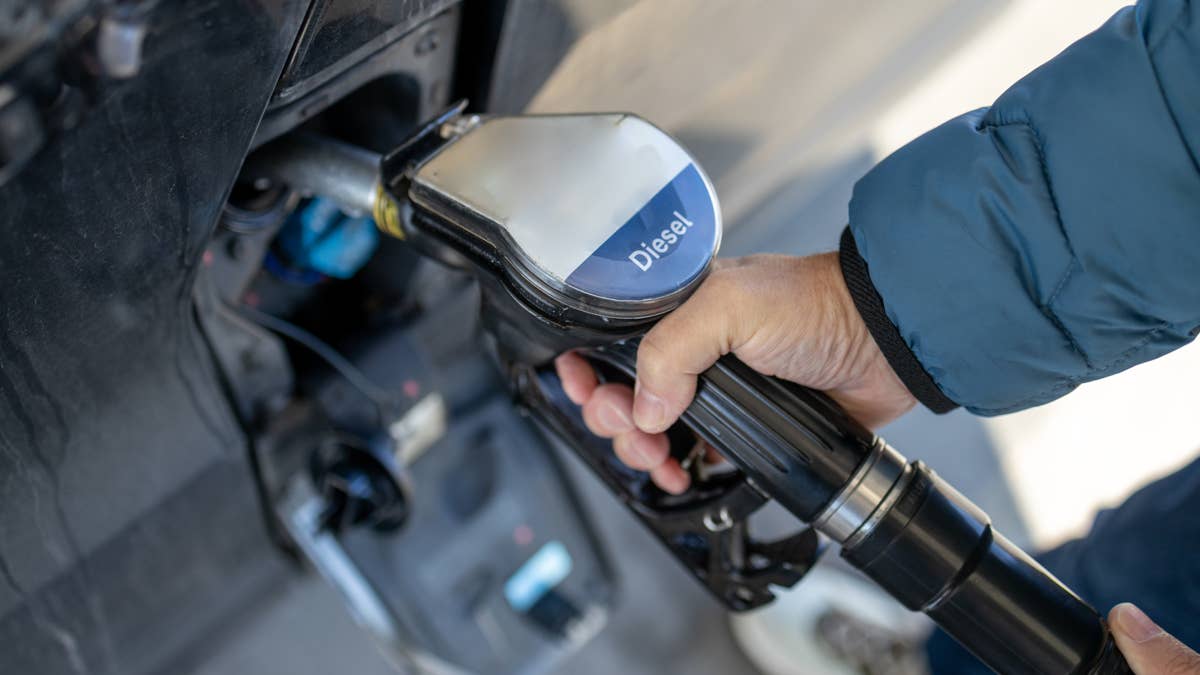 Diesel topped $6.50 a gallon and wholesale prices jumped 5.4%.
Why the fuel behind your groceries is climbing faster than gas
Diesel and gasoline both come from crude oil, but they answer to different customers.
“Gasoline prices tend to be driven by consumer driving patterns,” while diesel “is more tightly linked to commercial demand such as freight, construction, agriculture and industrial activity,” according to J.P. Morgan Wealth Management.
Supply is the other half of the problem. The conflict involving Iran has raised risks for energy flows through key Middle East routes, while refinery disruptions in Russia have cut the products available for export, the firm noted.
TheStreet’s Charley Blaine traced how Ukrainian drone strikes and Middle East tensions pushed diesel past $6 earlier this month. Refiners can’t simply make more diesel on demand, because it competes for the same capacity as jet fuel and heating oil.
Harvest season adds pressure right now, and heating demand arrives next. That timing leaves little cushion.
JPMorgan flags diesel as the inflation signal to watch
The national average for diesel hit a record $6.53 a gallon on Sept. 22, according to AAA. That’s nearly 77% above the $3.69 drivers paid a year earlier, reported J.P. Morgan Wealth Management.
The bank’s key point is about timing. Diesel “can show up in producer cost data before it becomes a consumer inflation story,” wrote Sergei Klebnikov of J.P. Morgan Wealth Management’s editorial staff.
The firm has sounded energy alarms before. In August, Klebnikov wrote that slow-healing supply chains around the Strait of Hormuz had “lowered the bar for a rate hike in September,” and the Fed hiked weeks later. The diesel piece extends that call from crude to the fuel that moves freight.
The guidance comes from the wealth arm’s editorial team rather than its research desk, but the numbers behind it are hard to argue with:
- Diesel ran about $2.78 a gallon above year-earlier levels in the week of Sept. 21, according to the U.S. Energy Information Administration (EIA)
- California diesel averaged $8.25 a gallon that week, the highest regional price, reported the EIA.
- Farm diesel cost $5.45 a gallon on Sept. 4, up from $3.02 a year earlier, reported the Detroit News.
- Diesel prices at the producer level jumped 24.1% in August alone, according to the Bureau of Labor Statistics.
Wholesale price data already shows the strain
The Producer Price Index (PPI) for final demand rose 0.4% in August and 5.4% over 12 months, according to the Bureau of Labor Statistics. Diesel alone accounted for more than a third of the month’s increase in goods prices, and truck freight transportation rose 2.0%.
The Consumer Price Index (CPI) tells a calmer story. Food-at-home prices were unchanged in August and up 2.2% from a year earlier, while overall consumer inflation ran at 3.4%, according to the BLS.
More Wall Street:
- Oppenheimer resets Microsoft stock price target after HQ visit
- The stock market is quietly accelerating a retirement wave
- JPMorgan gave up trying to call the end of the oil war
When I lined up the two reports, the gap stood out. Wholesale inflation is running two full points hotter than what you pay at the register, and JPMorgan’s framework suggests that pressure works its way down to shoppers over time.
“As contracts reprice and fuel surcharges take hold, more of that cost makes its way to the grocery store,” David Ortega, a food economics professor at Michigan State University, told Fortune.
Truckers and farmers pass the pain down the supply chain
Paul Russo, president of Wayne Industries in Michigan, now adds a 45% fuel surcharge to his trucking rates.
“I cannot let it linger because all of a sudden I’m eating all that,” he told the Detroit News.
I ran the numbers on a standard 300-gallon truck tank. At AAA’s record average, a full fill-up costs about $1,960, roughly $850 more than the same tank cost a year ago.
Not every carrier can pass that along. TheStreet’s Daniel Kline reported that 16 trucking companies filed for Chapter 7 or Chapter 11 bankruptcy in 30 days, and each failure removes capacity from the system.
Relief may not come quickly. “The physical stocks of these products are dwindling. This cannot go on forever,” Neil Atkinson, a senior fellow at the National Center for Energy Analytics, told Fortune.
How the Fed’s rate hike hits your portfolio
The Federal Reserve raised its benchmark rate by a quarter point to a range of 3.75% to 4% on Sept. 16, in a unanimous 12-0 vote. The central bank’s message was blunt: “Inflation is too high and has been for too long,” according to Charles Schwab.
Bond investors are pricing in more of the same. The 10-year Treasury yield just hit a 19-year high, which feeds directly into mortgage and auto loan rates.
For your portfolio, JPMorgan’s checklist is practical. Look for concentrated exposure to “transport-intensive or margin-sensitive areas,” and stress-test your plan for inflation that “stays firmer for longer,” the bank advised.
Companies with pricing power can pass diesel costs along. Businesses with thin margins, from regional carriers to grocers, often can’t, and their “profit margins and stock prices could come under pressure,” the bank warned.
What freight costs could mean for your winter budget
Watch three dates. The EIA’s next weekly fuel update lands Sept. 29, distillate inventory data follows each Wednesday, and September’s CPI report arrives in mid-October.
If wholesale inflation keeps running ahead of consumer prices, expect the gap to show up in delivery fees, restaurant menus, and your next grocery receipt.
You can’t control what a gallon of diesel costs. You can control whether your budget and your portfolio are built for a world where it stays expensive.
Related: Oil executives declared a fuel crisis, and diesel agrees
