
Today’s economic news is short but decidedly not sweet.
Gasoline prices may be easing, but American households are still paying more for groceries, healthcare, and other everyday expenses.
Now, a hotter-than-expected October inflation report has put a potentially much bigger Federal Reserve interest-rate increase on your kitchen table just in time for the holidays.
Fed Governor Christopher Waller said a 50-basis-point (0.5%) rate hike should be considered at the December policymaking meeting.
And Dallas Fed President Lorie Logan also warned that Fed officials may need to move faster and deliver at least two additional increases beginning next month to get inflation under control.
For Fed Chair Kevin Warsh, the stakes are growing. Six months into his leadership, the U.S. central bank’s credibility as an inflation fighter is facing a major test.
Following months of waiting for economic data to confirm what American consumers and businesses have known and experienced firsthand — that prices are simply too damn high — the Fed heads into its final meeting of the year Dec. 8-9.
In light of political and economic pressures, it faces a stark choice: increase short-term interest rates to restore its anti-inflation credibility or risk letting price pressures spiral further out of reach.
“(The) Fed is losing its inflation-fighting credibility. Consumers who rely mostly on wages, not their stock portfolios, are paying the price,’’ Diane Swonk, chief economist and managing director at KPMG, posted on LinkedIn.
Waller calls for bold action from the Fed on inflation
And those rate hikes could be massive if inflation continues to broaden away from supply shocks and into other sectors, as shown in the hotter-than-expected October Consumer Price Index at 0.4%, up from the 0.3% estimate, CNBC reported.
In October, food, energy, healthcare, recreation, medical care, motor vehicle insurance, and household furnishings all ticked up from the September readout. This is in part due to the geopolitical impact of diesel prices slamming the supply chain, causing businesses to pass along the pain.
Waller, speaking in London on Nov. 10 hours before the CPI release, upped the hawkish tone of the projected tightening cycle and said policymakers needed to take bold action if inflation came in hotter than the consensus forecast, which it did.
“In that case, I believe a 50-basis-point hike in the policy rate should be considered at the December meeting. Hiking only 25 basis points would put our credibility at risk, a risk I am not eager to take,’’ Waller said in prepared remarks.
“While I am pleased to see energy prices down from their high rates over the past week or so, they are still quite elevated relative to the start of the year, and the ultimate effect on inflation will depend on what levels are sustained,’’ he added.
TheStreet
Dallas Fed’s Logan echoes Waller’s call for rate hikes
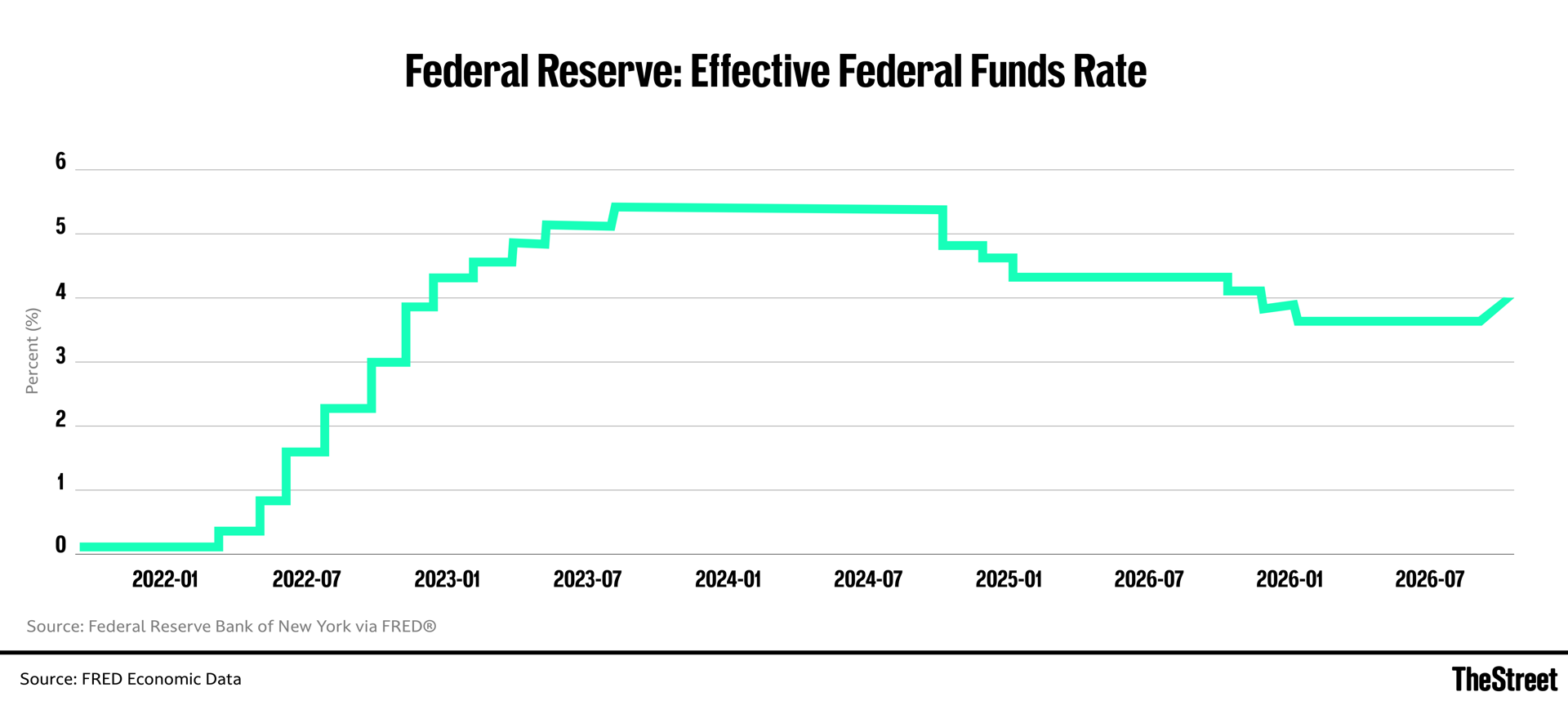
The Federal Open Market Committee voted 10-2 to pause the benchmark Federal Funds Rate at the target of 3.75% to 4% at its Oct. 28-29 meeting after approving a 25-basis-point (0.25%) hike in September.
Logan was one of the two dissenting votes in October, arguing that a 25-basis-point hike was needed to curb price pressures.
She upped her stance Nov. 10, saying in prepared remarks that “central bankers must not be too eager to call shocks temporary. Sometimes, a shock kicks off a new trend that will affect inflation for some time.”
More Fed:
- Scott Bessent just reframed the case for a December rate hike
- Fed Chair Kevin Warsh reveals October surprise inside interest-rate pause
Skipping one meeting does not change the monetary policy destination, she said.
“It remains clear to me, given the current outlook, that the FOMC needs to implement at least two more 25-basis-point rate increases,’’ Logan said, adding that it “may be possible to move more rapidly this winter than the FOMC has moved so far this fall’’ to achieve a modestly restrictive stance.
Traders eye possibility of jumbo rate hike in December
The CME Group FedWatch Tool had traders predicting on Nov. 10 a 90.5% probability of a 25-basis-point hike in December and a 9.5% chance of a 50-basis-point increase, both dramatic upticks from what I reported the previous day.
EY Chief Economist Gregory Daco said in a LinkedIn post that while the Fed justified its October hold by pointing to the lack of urgency to tighten policy, failing to deliver the expected December hike would risk calling into question its resolve to restore price stability.
“The possibility of a more aggressive 50bp hike at year-end should not be discounted. Governor Waller has raised that possibility, and several of the more hawkish FOMC members may favor a more forceful response to persistent inflation pressures,’’ Daco said.
Fed’s Warsh remains committed to price stability
October was the seventh consecutive month that consumer price increases outpaced wage growth. The labor market remains stable despite the low-fire, low-hire conditions.
Warsh repeatedly has said that the Fed is committed to its dual Congressional mandate: Use interest rates and balance-sheet policy to keep prices stable and the labor market at full employment.
That’s tricky.
- Lower interest rates support hiring but can fuel inflation. This risks fueling further inflation, potentially leading to an inflationary spiral.
- Higher rates cool prices but can weaken the job market. This increases the cost of borrowing and further stifles economic activity.
Related: Fed rate hike may not be ‘one and done’ if AI boom fuels inflation
Fed Vice Chair Michelle Bowman said in a Nov. 10 speech that she sees conditions in energy markets and the AI buildout as two important issues for the U.S. economy in the months ahead.
“Developments in these two areas could have material effects on both sides of our mandate and could influence my views on the path for monetary policy,’’ Bowman said, deferring a stance on interest rates to discussions with FOMC colleagues on Dec. 8-9.
Lack of Fed forward guidance leaves investors guessing
Under Warsh’s leadership, the central bank has deliberately shifted away from rigid, predictable forward guidance to financial markets. It’s left Wall Street guessing about the outcome of upcoming FOMC meetings.
This lack of communication is what some Fed watchers say is the cause of recent volatility in the stock market and sharp fluctuations in Treasury yields. Investors have tried to second-guess incoming economic data while inflation stays uncomfortably above the Fed’s 2% target.
The yield on the 10-year Treasury note, which is the benchmark for mortgage and car loan rates, climbed 14 basis points to 5.00% after the October CPI release on Nov. 10.
Meanwhile, the 30-year Treasury bond yield rose more than 11 basis points to 5.37%.
And the 2-year Treasury yield, which closely tracks short-term Fed rate expectations, soared 19 basis points to 4.738%.
