
California has a reputation for high taxes, but retirees may find some important advantages, including tax-free Social Security benefits, limits on property tax assessment increases and no state estate tax.
The financial consequences can depend on where retirement income comes from, how long someone has owned a home and when taxable transactions occur.
Dean Kernus, a financial planner and tax adviser with Willow Creek Financial in San Diego and a member of the AICPA Personal Financial Planning Champions Task Force, explains what retirees should consider before deciding whether to move to California or remain there in retirement.
Below is a transcript of my interview with Kernus, edited for brevity and clarity.
How can moving to California affect your taxes?
Bob Powell: If someone is planning to retire in California, what should they consider before moving, particularly if they have substantial unrealized capital gains or money in tax-deferred retirement accounts?
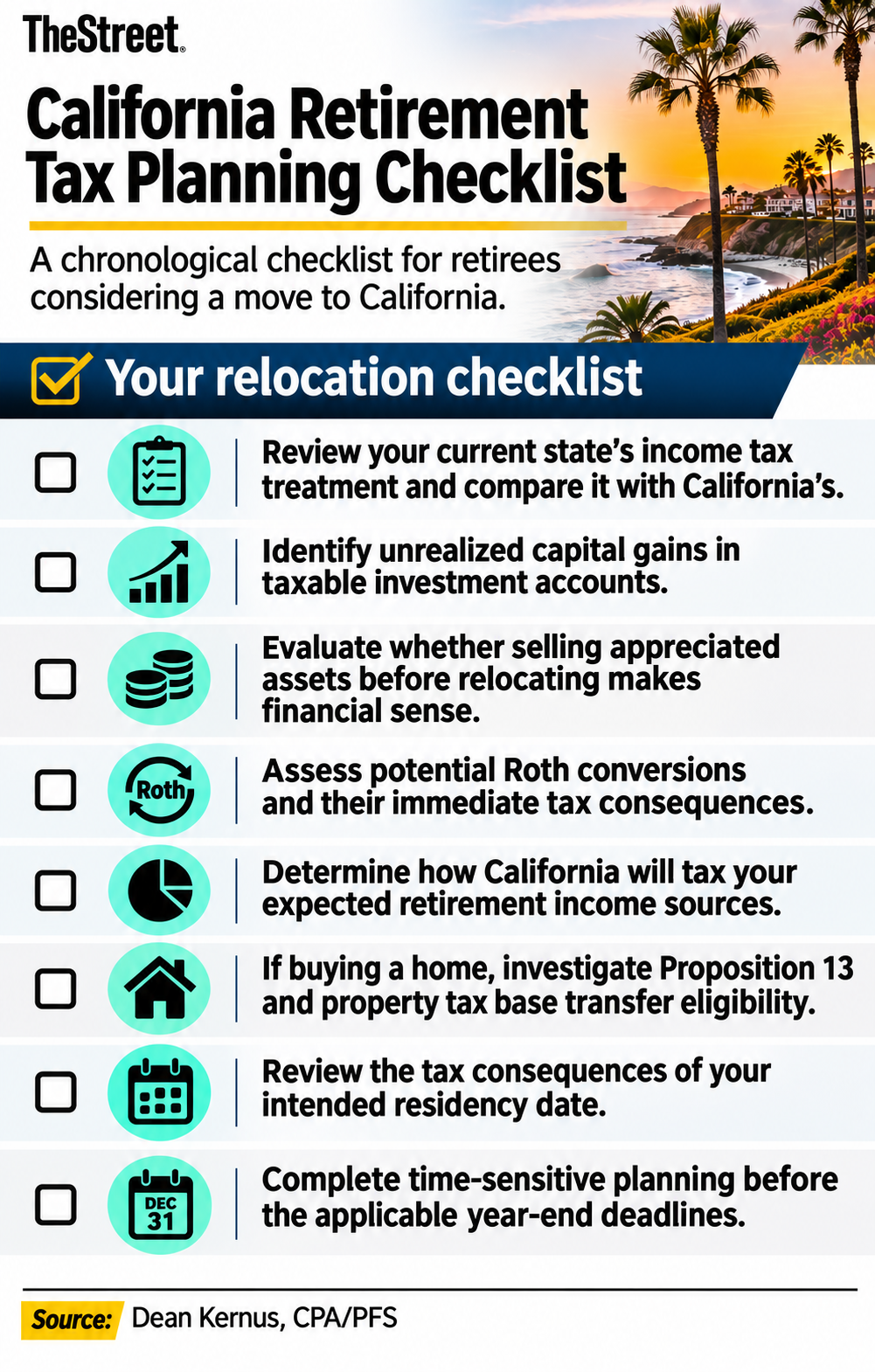
Dean Kernus: Given that you don’t get any breaks in California for capital gains taxes, if you’re going to move here from another state and you have large unrealized capital gains, sell the assets before you move to California.
That’s one idea.
Another is Roth conversions. If it makes sense to do Roth conversions and you’re living in another state with a lower income tax rate than California, it might make sense to do a conversion before you move.
Roth conversions are reported as ordinary income.
If you’re moving from a lower-tax jurisdiction to a higher-tax jurisdiction, you want to recognize as much income as makes sense before you move.
<strong>If you’re going to move here from another state and you have large embedded capital gains unrealized, sell it. I mean sell the assets before you move to California.</strong>
What forms of retirement income does California tax?
Powell: Let’s look at California’s income taxes. How high are they, and what should retirees expect?
Kernus: California income taxes can be high for certain people. For others, they’re pretty manageable.
California has nine tax brackets, ranging from 1% to as high as about 14.5% for people with income over $1 million, including additional taxes. It depends on where you fall in the income range.
Powell: How does California tax distributions from traditional IRAs, 401(k)s, and pensions?
Kernus: They’re treated as ordinary income, just like wages.
Powell: What about capital gains and dividends? They receive preferential treatment under federal income tax law.
Kernus: That’s another large area where California doesn’t conform to the federal tax code.
Capital gains and dividends are treated favorably for federal income tax purposes. In California, they’re treated like wages, as ordinary income.
Powell: And interest income?
Kernus: Same thing. Ordinary income.
Why are Social Security benefits different?
Powell: Many retirees rely on Social Security. How does California tax those benefits?
Kernus: That’s the flip side I alluded to. Social Security is not taxed in California. If you’re collecting a lot of Social Security, you could make out very well in California.
How can California property tax rules help retirees?
Powell: Property taxes are another important consideration for retirees. How do they work in California?
Dean Kernus, CPA/PFS
Kernus: It depends on the house and how long you’ve lived in it.
Property taxes start at 1% statewide. Local jurisdictions can add voter-approved taxes. When we do planning, we generally assume about 1.2%.
But there’s a cap on annual increases in assessed value. It can’t go up by more than 2% per year under the applicable rules. That’s another bonus of living in California.
In other jurisdictions, property tax assessments can jump significantly. California’s 2% cap can be very helpful.
Powell: That’s Proposition 13, correct?
Kernus: Exactly.
There’s another thing I’ll mention about property taxes. If you’re 55 or older and you sell your house and move into another house that’s not more expensive, you may be able to take your property tax base from your old house and apply it to the new house.
That can be very helpful if you’ve lived in your house a long time and then buy another home. It can go a long way toward saving taxes.
What other taxes should California retirees consider?
Powell: What about sales taxes?
Kernus: Sales taxes are a little higher than in some states.
The statewide rate starts at 7.25%, and local jurisdictions can add to that.
There are a couple of areas outside Los Angeles where the rate is 11.25%. The highest rate is generally around 10.75%.
But sales tax doesn’t apply to groceries or prescription drugs, which can be quite beneficial.
Powell: California also has an additional tax on higher-income residents. How does that work?
Kernus: California has a couple of unique taxes.
One is called the mental health tax. It’s an additional 1% on taxable income above $1 million. There’s also a state disability tax of 1.2% that applies to W-2 earnings in California.
When you layer those taxes on top of the regular income tax, you can see how the rate can get very high. I haven’t seen those highest levels in my own practice, but they can get there.
What estate taxes does California impose?
Powell: Are there any other tax advantages retirees should know about, particularly when it comes to estate planning?
Kernus: There’s no estate tax in California. That’s separate from income taxes, but it can be helpful if you have a fairly large estate.
Powell: And there’s no state inheritance tax, either?
Kernus: Exactly. No inheritance tax and no estate tax.
When should retirees make tax planning decisions?
Powell: We’ve talked about several ways retirees might manage their taxes. How important is the timing of those decisions?
Kernus: There’s a lot of planning that goes on before Dec. 31 every year.
Powell: We often remind people there’s a difference between tax preparation and tax planning. Tax planning needs to take place well before someone prepares their return, correct?
Kernus: Exactly. Once you’re at the preparation phase, you’re kind of done. There’s not much you can do.
Should you retire in California despite its taxes?
Powell: Taking everything into account, is California a good place to retire, whether someone already lives there or is considering moving?
Kernus: California’s a great place to retire.
Notwithstanding the tax regime, you can work around that to some extent.
Health care here is great. The climate’s great. The people are great.
I’m not a native. I came from the East Coast, and it really struck me how different the general mentality is.
California has a reputation for a reason. It’s a good place.
Related: IRS 2027 retirement limits: 401(k) caps jump while IRA limits freeze again
