
The stock market has defied doubters who assumed post-tariff tantrum volatility would crimp earnings, derail AI tailwinds, and leave investors wringing their hands. The naysayers weren’t wrong to worry about political uncertainty or stock market valuations, but stocks have mostly absorbed mild setbacks over the past three years, with the benchmark S&P 500 on its way to deliver a fourth consecutive year of double-digit returns.
Returns like that aren’t common, but despite a four-year bull market that has sent the S&P 500 up about 119%, there’s reason for optimism, according to CFRA strategist Sam Stovall.
In a research note shared with me, Stovall, who has helped professionals make sense of the stock market since the 1980s, points out that it’s historically hard to derail a bull market after four consecutive years of gains.
“The average gain in the fifth year of bull markets since WWII was nearly 21%. Only one of the bulls that lasted four years did not survive until its fifth anniversary,” wrote Stovall.
S&P 500 rides earnings coattails to a lower-than-average valuation
When I was on the sell-side in the late 1990s, my mentor used to remind me, “stocks follow earnings over time.”
That’s certainly been true this time around, thanks to AI optimism following the 2022 bear market and historically high earnings growth.
Also read: Goldman Sachs sends a stern warning to stock market investors
S&P 500 companies saw earnings tumble 12.7% in 2022. Since then, they’ve risen 11.4%, 9.2%, and 16.87% in 2023, 2024, and 2025, respectively, according to Multpl. The S&P 500 has climbed by 24.2%, 23.3%, and 16.4% in those years.
The earnings trend has accelerated in 2026, fueling additional upside.
According to FactSet, S&P 500 earnings growth will clock in at 29% year-over-year in the third quarter, marking “the third-straight quarter of earnings growth above 25%.”
So far, the S&P 500 is up 12.35%.
The tailwind for stocks isn’t lost on Stovall, who points out that the index’s forward price-to-earnings (P/E) ratio has fallen as earnings growth has outpaced price returns.
“The S&P 500’s P/E on forward 12-month EPS stands at 19.8x, a 0.4% discount to its 10-year average,” wrote Stovall.
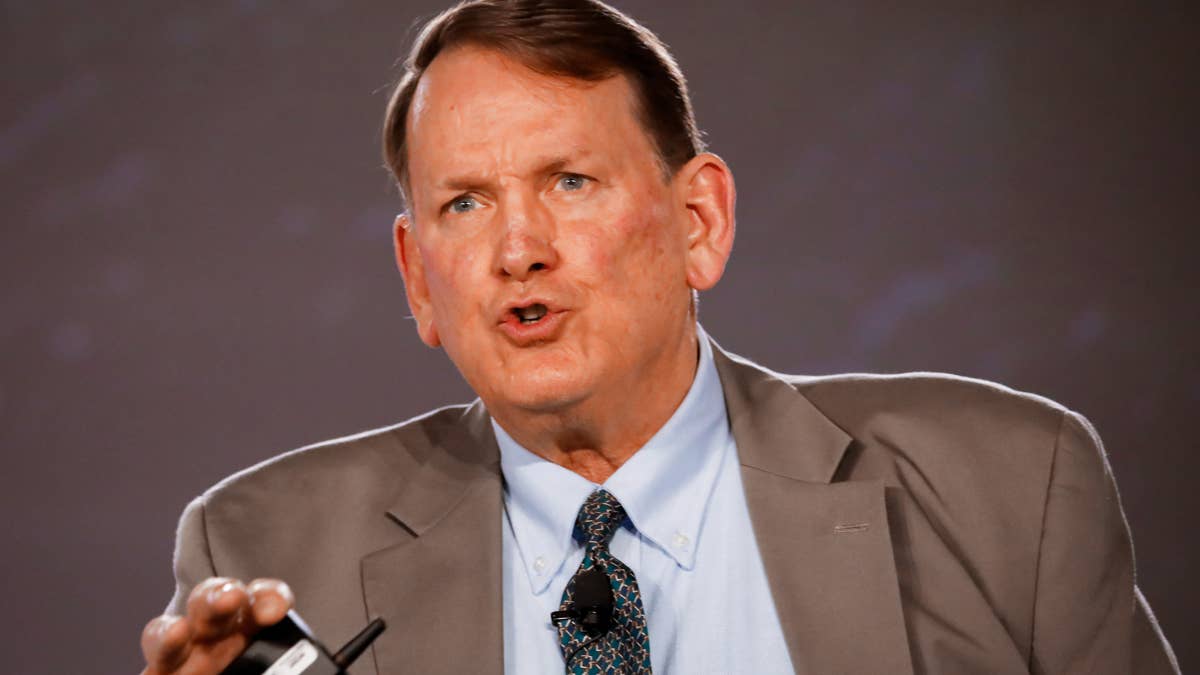 Sam Stovall says the S&P 500 is usually up again after four consecutive yearly gains.
Stovall says S&P 500 has more room to run
The stock market faces a headwind from higher interest rates, with 10-year Treasury yields firmly over 5%, making them increasingly competitive to stocks. Higher Fed interest rates to crimp inflation are also a headwind for economic activity.
Still, Stovall notes that despite the jump in the 10-year yield this year, the current 5.24% yield only ranks in the “middle of other fourth-year bulls.”
More Wall Street:
- Nvidia and Micron are about to lord their successes all over Wall Street
- Nvidia, Palantir, and Alphabet send waves through Wall Street
- Wall Street elites will pocket windfall from record $46 billion profits
CFRA doesn’t necessarily expect the S&P 500 to deliver a fifth consecutive year of double-digit gains in 2027, though, given that returns this bull market have been higher than usual.
“This is the only bull market since WWII that posted double-digit advances in each of the first four years. Even though the average price change for fifth-year bull markets is nearly 21%, chances are slim that a double- digit gain will be recorded in year five,” said Stovall.
The reality is that double-digit gains have only happened in one five-year stretch of a bull market, and that was 1995 to 1999 during the dot-com boom.
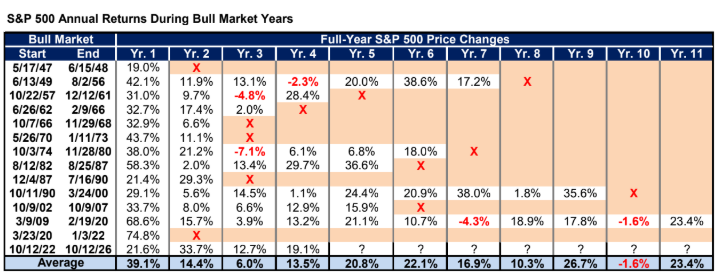 In the past, when the S&P 500 has been up in four consecutive years, the fifth year has usually been positive too.
CFRA/Sam Stovall
Still, if history rhymes, stocks may still provide investors with a reason to stick around.
The S&P 500 earnings season gets into the swing of things this week with 77 member companies reporting results. Stovall expects a strong showing that will help full-year earnings growth clock in over 30%, with additional profit upside in each of the next two years.
“For full-year 2026, S&P 500 EPS are projected to have risen 31.7% Y/Y and are expected to be followed by a 16.8% increase in 2027 and +16.9% in 2028,” noted Stovall.
How much more room could the S&P 500 run based on history?
“Bull markets that [have] lasted this long remained alive for an additional 34 months and enjoyed an average total gain of 232%,” said Stovall.
