
First of six-part series
Artificial intelligence could help 401(k) participants make better decisions about saving, investing, withdrawals, and retirement income, according to a new 28-page report just published by the Society of Actuaries Research Institute.
But inaccurate advice, incomplete information, and conflicts of interest could also lead to costly mistakes, according to the report, AI and Its Potential Impact on Defined Contribution Plans: Insights from an Expert Panel, which was authored by Ronald L. Poon Affat.
Given the two extremes, workers saving in 401(k) plans, people approaching retirement, and retirees deciding what to do with their accumulated savings need to be mindful of the following.
Artificial intelligence could help you make smarter decisions about your 401(k). But what happens when the advice sounds reasonable and turns out to be wrong?
Consider, as the report noted, a worker who wants to skip a 401(k) contribution near the end of the year to cover an unexpected expense.
A general-purpose AI chatbot might suggest that doing so makes sense, particularly if the worker has already contributed a substantial amount to the plan.
There’s just one problem.
Suppose you earn $100,000 a year and your employer matches 50 cents for every dollar you contribute to your 401(k), up to 6% of your pay. If you contribute 6% throughout the year, your employer would contribute $3,000.

But what if you contribute more than 6% during the first 11 months and then stop contributing in December? Even if you’ve contributed at least $6,000 for the year, you might not receive the full $3,000 employer match.
Why? Some employers calculate matching contributions paycheck by paycheck rather than annually. If you don’t contribute during a particular pay period, you generally won’t receive a matching contribution for that paycheck.
Some plans provide a year-end true-up, an additional employer contribution that makes up for certain missed matching contributions when an employee’s annual contributions qualify for a larger match. But not all plans offer one.
Without a true-up, you could permanently lose some of the employer’s matching money, even though you contributed enough over the year to otherwise qualify for the full annual match.
That’s one of the examples highlighted in the Society of Actuaries Research Institute’s report examining how artificial intelligence could reshape 401(k)s and other defined contribution retirement plans.
According to the report, an AI tool with access to the specific provisions of a worker’s retirement plan could recognize the potential loss of matching contributions and offer different guidance. A general-purpose chatbot, lacking that information, might not.
The potential benefits extend beyond avoiding costly mistakes. The report suggests AI could also provide more personalized retirement education, tailoring explanations and guidance to a participant’s financial circumstances, level of understanding, and priorities.
Rather than offering the same information to everyone, AI could help workers better understand the choices available to them and the consequences of those decisions.
And therein lies both the promise and the peril of using AI to make retirement decisions.
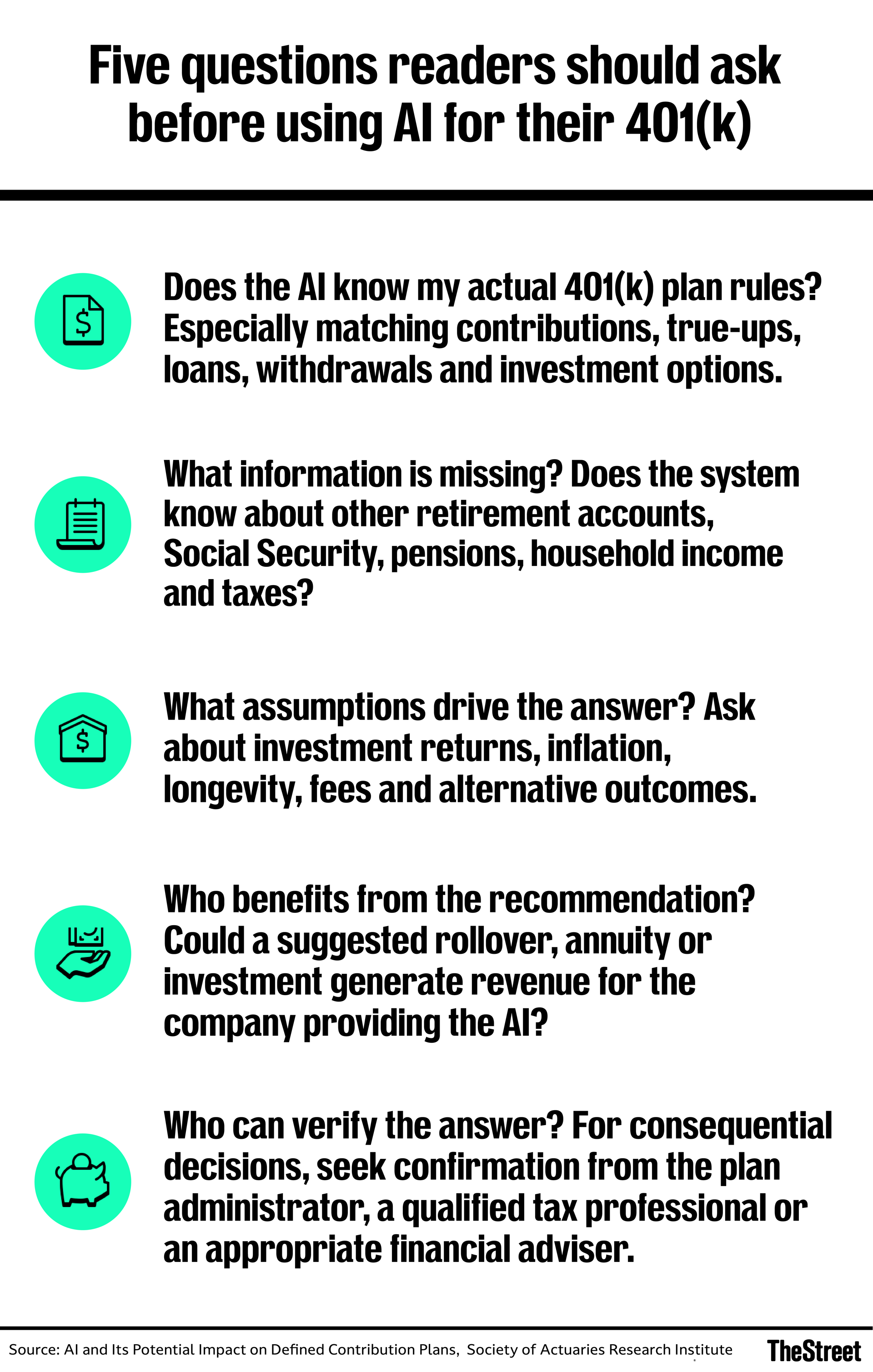
On the one hand, AI could help workers save more effectively, make better investment decisions, avoid costly rollovers, and determine how much they can safely spend in retirement.
On the other hand, even seemingly sound recommendations could prove costly if the technology doesn’t understand the rules governing a particular retirement plan or the circumstances of the person asking for advice.
The larger question, according to the report, isn’t simply whether AI can provide retirement guidance. It’s whether that guidance is accurate, relevant, and ultimately serves the interests of the person whose retirement savings are at stake.
What this means for your 401(k)
Before following AI-generated advice about changing your contributions, check how your employer calculates its matching contributions and whether your plan provides a year-end true-up.
More Retirement
- The year-end RMD trap: Why waiting until late December could cost retirees 25%
- The “Gap Year” Roth: Early retirees slash lifetime taxes before RMDs hit
- Tax-loss harvesting guide: $3,000 limit & wash-sale rules
You can find that information in your plan documents or ask your benefits department or plan administrator. And when using AI, distinguish between a general-purpose chatbot and a tool that has access to your plan’s actual provisions. The same question could produce different answers, and only one may account for the rules that apply to you.
Related: Veterans may be leaving valuable benefits on the table: What to check
