
T-Mobile CEO Srini Gopalan is drawing a line in the sand on a potential deal with SpaceX amid mounting competitive pressures.
SpaceX’s Starlink, which offers satellite internet service plans priced from $55 to $130 per month, is seeing growing consumer demand.
New Street Research recently found that Starlink has about 4 million U.S. broadband customers, according to a Telecom Gazette report. The research firm estimated that figure at 2.7 million in May.
Additionally, SpaceX has recently been working to build a terrestrial network for its Starlink Mobile service. On an August earnings call, SpaceX Chief Operating Officer Gwynne Shotwell said she expects the upcoming service to “acquire quite a few” T-Mobile, Verizon, and AT&T customers.
SpaceX later entered into an agreement to acquire nationwide low-band spectrum licenses (requires FCC approval), which “will pave the way for Starlink Mobile to become a major mobile carrier in the US,” it said in an Oct. 8 press release.
T-Mobile CEO shuts down MVNO partnership with SpaceX
As SpaceX aims to become a significant player in the wireless industry, Gopalan has ruled out T-Mobile entering an MVNO (mobile virtual network operator) partnership with the satellite provider.
Under an MVNO agreement, SpaceX would sell wireless plans under its own brand while paying T-Mobile to use its cellular network.
“We’ve been very clear that in terms of satellite, we see it as a complementary product,” said Gopalan on an Oct. 28 earnings call. “And therefore, we don’t really see the room for an MVNO for satellite or SpaceX in that context.”
He said that T-Mobile is already “steaming ahead” in positioning itself to compete in the fields of Physical and Edge artificial intelligence. It is also building its 5G standalone network and developing 6G, which he said the company sees itself as “a lead in terms of those capabilities.”
Read more: T-Mobile and Verizon face a new broadband rival
“We see no space for an MVNO here because, well, what additional capabilities does it give us? Why does it change our ability to compete?” said Gopalan. “If we’re talking about SpaceX as a customer or us being a customer of them, that’s a purely commercial agreement.”
“But the answer to the MVNO is I see no room for an MVNO with SpaceX either on the consumer side or on the Physical and Edge AI side,” he continued.
His comments come after New Street Research policy analyst Blair Levin said in a note to investors in May that “any satellite operator would need an MVNO or some sort of facilities-based extension to compete with a facilities-based carrier,” according to a Fierce Network report.
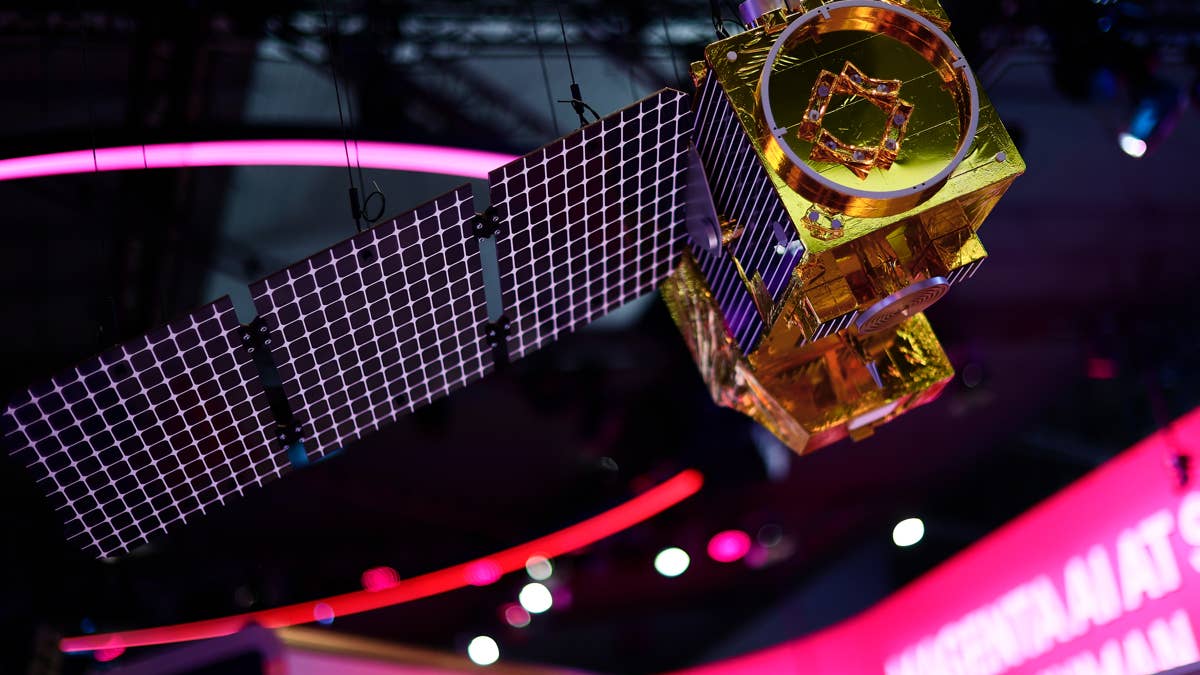 T-Mobile CEO Srini Gopalan has rejected an MVNO partnership with SpaceX.
T-Mobile CEO adds limits to potential SpaceX broadband partnership
Gopalan also turned down the idea of working with SpaceX or other satellite providers to strengthen T-Mobile’s fixed wireless access (FWA) internet business, which he said is seeing “very strong momentum.”
“We’ve got a great product in FWA and really, in many ways, except for some deep rural parts, satellite is an inferior version of FWA with even more constraints in terms of things like what is the size of the beam, right? So I don’t see the synergy there between FWA and satellite,” he said.
More T-Mobile News:
- T-Mobile raises another fee customers pay each month
- T-Mobile quietly plans new perks to keep customers from switching
- T-Mobile adds monthly fee to a new iPhone feature for customers
He said that two-thirds of T-Mobile’s customers come from “dense urban areas,” and the company sees “huge growth opportunities” in those locations under the fallow capacity model.
While Gopalan ruled out T-Mobile partnering with satellite providers to strengthen or expand its FWA service, he isn’t shelving the idea of offering satellite as a separate product.
“If it’s a complementary product, I’m very happy to look at a resale arrangement,” he said.
T-Mobile already offers satellite service as a complementary product in its wireless business.
It launched T-Satellite in July 2025, a direct-to-cell service it partnered with SpaceX to develop. The service is powered by over 650 Starlink satellites and costs T-Mobile customers $10 a month as an add-on.
T-Mobile recently launched satellite venture with rivals
Gopalan’s recent stance on the idea of T-Mobile deepening its relationship with SpaceX comes after the carrier launched a joint venture with Verizon and AT&T on Oct. 1, which aims to nearly eradicate coverage gaps in the U.S. using satellite connectivity.
The venture, first announced in May, will allow the three carriers to coordinate satellite connectivity during emergencies, including extreme natural disasters and other major disruptions.
It also aims to make satellite services more accessible across providers, creating a more consistent customer experience and helping accelerate the rollout of new features.
The initiative could introduce a new competitive challenge for Starlink and other satellite providers. The carriers said in a press release that the venture is intended to “enhance competition” and foster innovation. However, they also clarified that “existing carrier-satellite agreements will remain in place.”
Related: Historic T-Mobile merger worth $300 billion put on ice
