Tesla (TSLA) wants to put customers behind the wheel of a car that doesn’t have one.
The electric-vehicle maker is trying to begin delivering its Cybercab to customers before the end of 2026, Tesla Vice President of Vehicle Engineering Lars Moravy said during the company’s third-quarter earnings call.
The Cybercab and nearly every vehicle parked in an American driveway differ in one significant way.
You cannot drive it.
Cybercab lacks pedals, mirrors, and a steering wheel. Since the two-seat car is built to drive completely on its own, Tesla’s upcoming consumer rollout will be one of the largest tests to date of whether Americans and regulators are prepared to see a completely autonomous car as something that individuals can really own.
According to Reuters, Tesla plans to start small before expanding customer deliveries.
That proposal is especially intriguing because of its timeliness.
The National Highway Traffic Safety Administration is now looking into how Tesla concluded that Cybercab conforms with federal vehicle-safety regulations.
For investors in Tesla, that transforms an odd-looking vehicle into something much more.
Elon Musk, the company’s CEO, is increasingly arguing that robots, autonomous vehicles, and artificial intelligence are more important to Tesla’s future than just boosting sales of electric vehicles.
Perhaps the first product that compels consumers to fully wager on that idea is Cybercab.
Tesla customers would have no backup driver
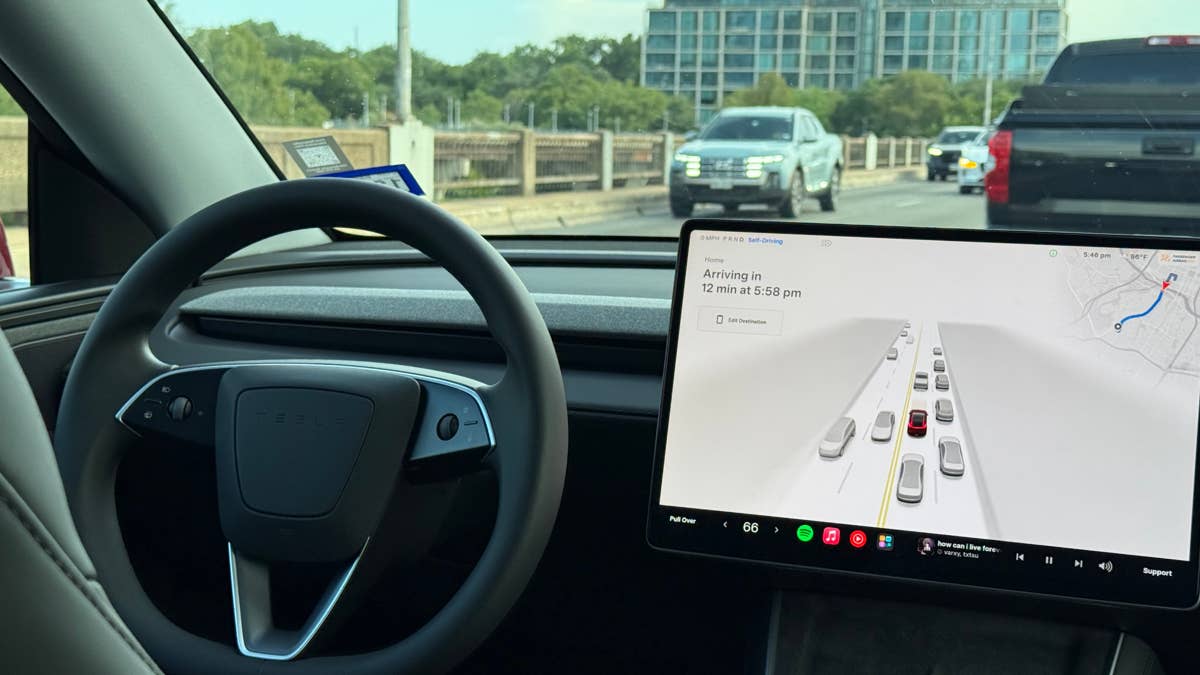
Almost every autonomous vehicle still provides somebody a fallback. A steering wheel lets a human take over. Brake pedals let a driver stop the car. Cybercab removes those options entirely.
With butterfly-style doors and a large central display in place of traditional driver controls, Tesla created the gold two-seater expressly for autonomous driving.
Thus, purchasing one necessitates embracing a radically altered relationship with the car.
The person seated inside cannot just grasp the wheel if the program fails to finish the journey.
That’s why Tesla’s customer-delivery goal is so important.
According to Moravy, Tesla is presently adding Texas-made Cybercabs to its Robotaxi fleet, but it hopes to start selling a few to clients by year’s end.
Tesla would then learn more about ownership, deliveries, and managing autonomous vehicles in private hands before scaling further, according to Reuters.
Musk somewhat moderated the consumer perspective.
He said that rather than taking the place of the Model 3 or Model Y as traditional personal automobiles, the vast majority of Cybercabs are anticipated to stay owned by Tesla and function as transportation-as-a-service vehicles.
However, even a small-scale consumer deployment would go too far.
Tesla would also provide users with proof of the autonomous vehicle’s safety.
Some clients might have to purchase the machine.
 Tesla wants to sell you a car you can’t drive yourself
Federal rules were written for cars people drive
Manufacturing the Cybercab may not be the greatest challenge facing Tesla.
It could be demonstrating that an automobile without traditional controls can run lawfully on a large scale.
More Tesla:
- UBS holds its ground on Tesla after mixed delivery results
- Wall Street bank makes radical Tesla call after Q3 deliveries news
- The Robotaxi payday Tesla promised owners isn’t coming
After Tesla started using Cybercabs for commercial purposes in Austin on September 4, NHTSA launched an inquiry.
The government is investigating Tesla’s self-certification that the car conforms with relevant Federal Motor Vehicle Safety Standards.
The majority of those criteria were established with human-driven vehicles in mind.
The NHTSA explicitly said that it will examine Tesla’s handling of standards pertaining to a vehicle without conventional human controls.
The agency is examining the basis for Tesla’s self-certification that the vehicle complies with applicable Federal Motor Vehicle Safety Standards.
To better support autonomous cars, the government is changing a number of standards.
However, it also made clear that until such modifications are finished, the current standards are still in force.
Tesla has until Oct. 30 to respond to the agency’s questions, Reuters reported.
The process produces a unique race.
According to Tesla, scaling up Cybercab production will not be too difficult.
However, the regulatory process for Cybercab could be more difficult.
Cybercab matters to Tesla stock for a bigger reason
Tesla is already able to produce a significant number of Cybercabs.
According to its third-quarter report, Texas has more than 125,000 installed yearly Cybercab manufacturing capacity.
Tesla also said that Cybercab entered its Austin Robotaxi fleet during the quarter and that it had accumulated nearly two million unsupervised Robotaxi miles by the end of September.
The challenge now is turning those technological milestones into a scalable business.
Tesla plans to expand Cybercab service to Dallas next month, according to Reuters.
Additionally, Musk depends increasingly on initiatives like Cybercab.
Although cars currently account for the majority of Tesla’s earnings, Musk has spent years urging investors to see the firm as a platform for robotics, artificial intelligence, and autonomous vehicles.
Cybercab is right in the midst of that dispute.
Tesla will go closer to demonstrating that it can offer transportation rather than just automobiles if it can produce vehicles without driver controls, get regulators’ approval, and ultimately put them in the hands of consumers.
That transition takes longer when regulatory obstacles or autonomous restrictions limit the vehicle to a small number of managed fleets.
The steering wheel matters because of its importance.
Eliminating it spares Tesla from having to build a car with a human driver in mind.
However, it also eliminates the simplest backup in the event that autonomous software makes a mistake.
If Full Self-Driving is not available, a regular Tesla can still drive itself.
Cybercab is unable.
As a result, Tesla wants consumers to wager far more on its software than they did on the Model 3 or Model Y.
The fact that Tesla created a vehicle without a steering wheel isn’t the only unexpected aspect.
It did so already.
When Tesla attempts to give the keys to someone outside the corporation, at least in a metaphorical sense, that will be the tougher test.
And Tesla says that could happen before 2026 is over.
