
While Walmart and Target have made some changes to their self-checkout rules, both chains still rely heavily on customers scanning their own items and checking themselves out.
Kroger and Home Depot remain committed to self-checkout, using it heavily across their stores.
New data, however, shows that shoplifting has been a growing problem.
“More than half of self-checkout users who deliberately took an item without scanning say they expect to do it again. A new analysis from The Law Offices of Tad Nelson & Associates places that repeat intent against FBI records showing 2025 shoplifting reports remained 7.5% above 2023.
“Detection does not appear to end the behavior for everyone. 46% of intentional self-checkout thieves said they had been caught. Separately, 31% said they felt no remorse,” according to self-reported survey data.
The timing adds urgency, with the Council on Criminal Justice reporting that shoplifting rose 4% in the first half of 2026, even as most major crime categories declined. That study tracks crime in a sample of U.S. cities, so the figure does not represent a definitive nationwide shoplifting increase.
Self-checkout remain popular
While Dollar General removed self-checkout from thousands of stores, many retailers have not.
Theft has been a Dollar General problem for years.
CEO Todd Vasos addressed it during the company’s fourth-quarter 2023 earnings call and shared some clear steps the company was taking to address the problem.
“Our second course of action will apply to all remaining stores with self-checkout, where we have begun limiting self-checkout to transactions consisting of five items or less. And finally, over the first half of the year, we plan to completely remove self-checkout from more than 300 of our highest shrink stores,” he said.
Target and Walmart have cut the item limit for self-checkout transactions in some stores, but they still rely heavily on the technology. Kroger has implemented selective changes in some stores as well, but has not made any widespread effort to return to cashier-led transactions.
- Kroger has more than 2,719 grocery retail stores across 35 states and the District of Columbia under approximately 20 different regional banners that historically average 10 self-checkout terminals per location.
- Walmart remains the absolute king of self-checkout volume. The chain historically averaged about 10 kiosks per store across more than 4,600 locations.
- Source: Jeff Rossen, Rossen Reports
- Target has active self-checkout stations in all but 200 of its roughly 1,950 U.S. stores.
- Source: Target
- Home Depot relies incredibly heavily on self-checkout kiosks due to the DIY nature of its clientele. Across its roughly 2,000 U.S. hardware warehouses, the vast majority of front-end lanes are fully automated, though they are heavily assisted by roaming associates who help scan large, bulky building materials.
- Source: Kiosk Industry
“One of the deep secrets is that, in many cases, they know you’re stealing, but let you get away with it until they hit the felony threshold,” Rossen shared.
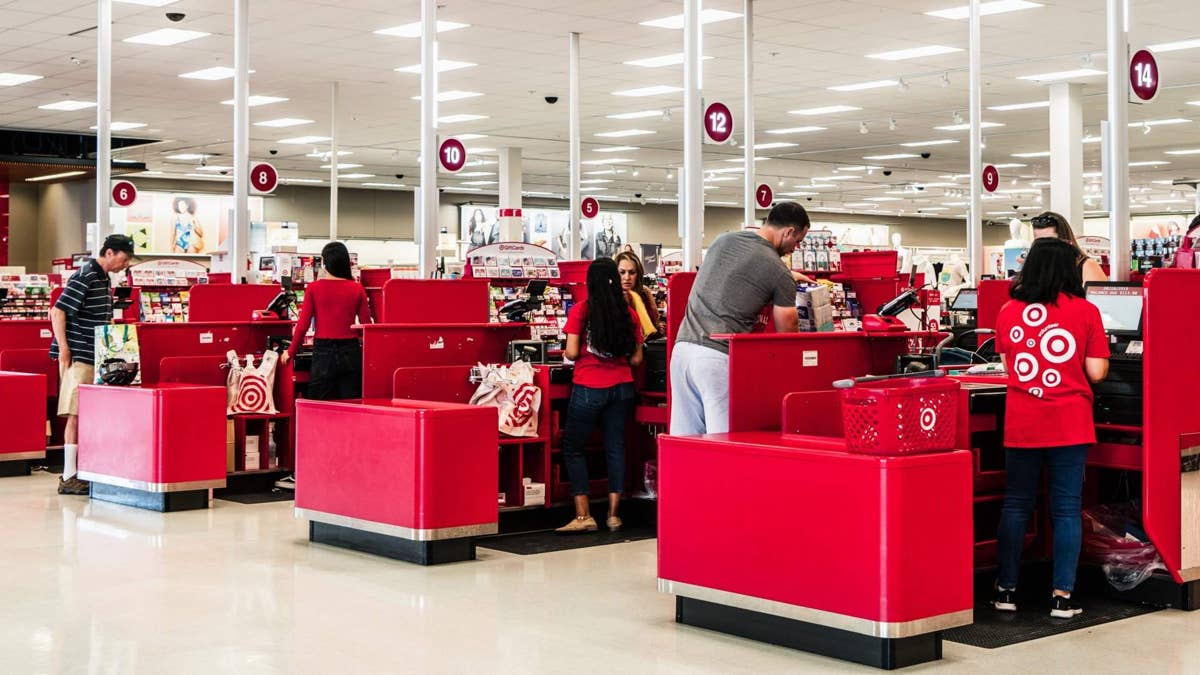 Nearly every Target still offers self-checkout.
Shutterstock
The self-checkout numbers are not encouraging
“America’s Shoplifting Hotspots, the 2026 All-State Shoplifting Index,” shows that some trends are not favorable for Walmart, Target, Home Depot, Kroger, and other retailers that rely on self-checkout.
Key findings included:
- 27% of self-checkout users said they had deliberately taken an item without scanning. LendingTree recorded 15% when it asked the same question in 2023.
- 23% reported witnessing self-checkout theft within the previous year.
- 14% said they had been accused of taking an item without scanning, despite not taking anything.
- 36% said they had accidentally left a self-checkout with an unscanned item. Among those accidental cases, 61% said they kept the item the last time it happened.
LendingTree’s July 2026 survey of 2,000 U.S. consumers found that food and nonalcoholic drinks were the most commonly reported stolen items, cited by 30% of respondents who said they had shoplifted. Clothing, accessories, and jewelry followed at 25%, while personal hygiene products were reported by 20%.
“The places where respondents reported stealing reinforce that picture. Grocery stores were the leading location, with 39% of respondents who had shoplifted saying they had done so there. Dollar stores ranked second at 28%, followed by department stores at 25%. Stores with self-checkout and convenience stores were each cited by 21%,” the Tad Nelson Law Offices report shared.
RTM Nexus CEO Dominick Miserandino believes retailers must balance multiple priorities when it comes to loss prevention.
“The problem for retailers is that catching someone doesn’t necessarily stop them. You can add cameras, security and technology, but if getting caught isn’t much of a deterrent, you’re spending more money to fight the same problem. Walmart, Target, Kroger and Home Depot still have to protect employees and customers without turning the store into a fortress,” he told TheStreet.
Retailers including Walmart, Kroger, Target, and Home Depot do not routinely disclose detailed loss-prevention tactics. Publicizing specific procedures could make it easier for shoplifters to work around them.
Related: Albertsons follows Kroger in putting harsh cuts, store closures in play
