
The world spent 2026 quietly burning through its energy safety net. Chevron’s boss says the cushion is almost gone.
At a World Economic Forum energy dinner this week, oil executives kept circling back to one topic: barrels in storage.
Everyone is watching tankers shuttle through the Strait of Hormuz and counting how much oil is left in tanks as winter approaches.
Saudi Aramco’s CEO has pointed to less than six billion barrels of commercial inventories remaining, a CNBC anchor noted.
For drivers, truckers and families heating their homes, this number is quite significant.
Think of it as the spare tire of the global energy system. So when Chevron’s top executive was asked how fragile things are, his answer stood out.
How oil inventories protect consumers
Oil gets stored in three main places. Companies keep some on hand, governments save some for emergencies, and some sit on sea tankers for sale.
The stored oil helps fill the gap when supply is cut off. It also keeps gasoline and diesel flowing until supply stabilizes.
Also Read: HSBC sets new Chevron price target amid Iran tensions
In a CNBC interview, Chevron (CVX) CEO Mike Wirth explained:
“We came into this year with high inventories, high inventories in commercial stocks held by companies, high inventories in strategic stocks held by governments around the world, and actually significant inventories on the water.”
Most of that oil on the water was sanctioned by the U.S. or the European Union and struggled to reach markets.
Chevron CEO says energy buffers are drained
Then, one by one, the cushions disappeared. Here’s what Wirth says happened over the past several months:
- Companies drew down their commercial inventories.
- Governments released strategic stocks.
- Sanctioned barrels were allowed to reach buyers.
- The G7 moved to release another 100 million barrels as diesel prices spiked.
“Those are all buffers in the system that have bought us time, but they’ve been drained,” Wirth said. “And so we’re at much lower levels of inventory right now, and it makes the system more vulnerable to disruption.”
He called it “a very serious situation.”
Wirth supports the policy moves from the U.S., the EU, and the G7. Releasing strategic stocks during a real supply risk is precisely what they were built for, he said.
But Wirth was clear about the limits. “They all buy time,” he explained. The real problem is “constrained flows out of some of the biggest producing areas in the world.”
Put simply, emergency supplies can delay a shortage but can’t replace oil that isn’t flowing.
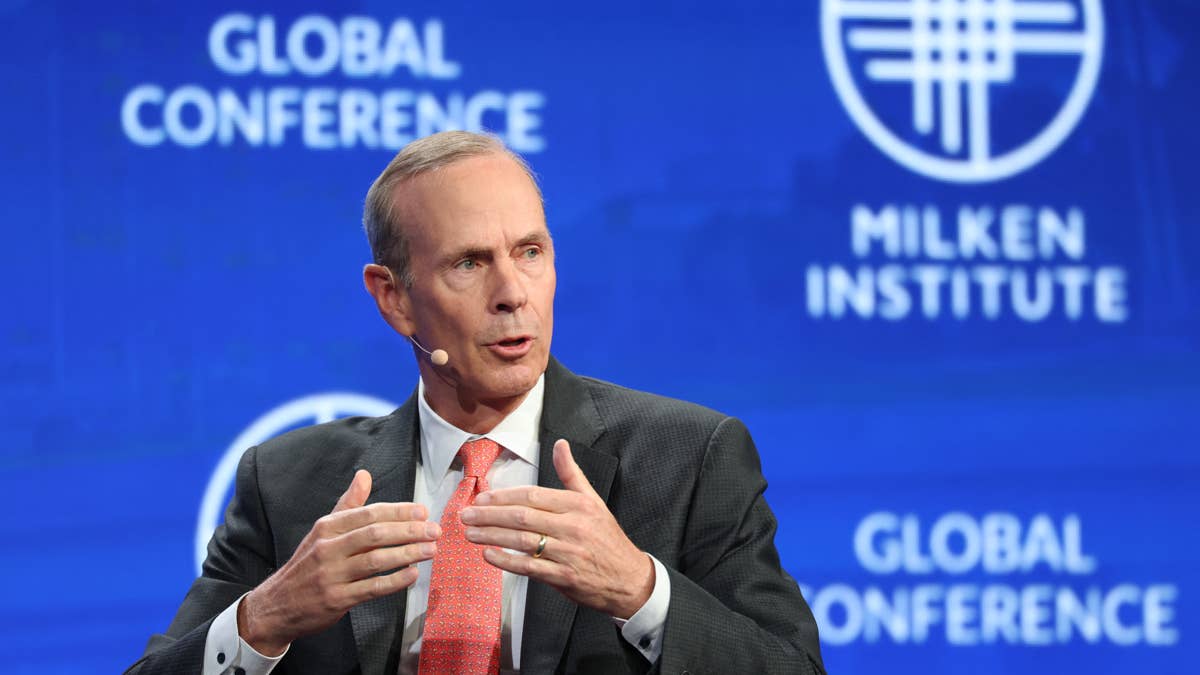 Chevron CEO Mike Wirth expects oil prices to remain volatile amid supply glut.
PATRICK T. FALLON / Getty Images
Why oil prices could swing both ways
Wirth isn’t calling for a price spike.
A resolution in the Middle East could send oil prices sharply lower. Chevron CFO Eimear Bonner said in September that oil prices had moved roughly $35 in a single month.
“We can’t control where the price goes. We can’t predict where the price goes. I’ve learned to be humble about our ability to predict the future,” Wirth said.
His playbook is old school. Keep a strong balance sheet, invest with discipline, and focus on operational efficiencies.
Notably, Chevron hit record oil and gas production and record refinery utilization this year.
Chevron bets big on Venezuela and the Permian
Chevron is also adding supply where it can. Bonner laid out the plan at Barclays’ 40th annual energy and power conference on Sept. 8.
Venezuela remains a key region where Chevron produces about 280,000 barrels a day and expects to reach 600,000 by 2031. It plans to invest $7 billion over five years in the South American country, where total costs run under $20 a barrel.
More Oil & Gas:
- Goldman Sachs doubles down on oil price forecast for 2026
- Drivers lose control over gas price squeeze
- A big shift in the U.S. energy market is about to happen
The Permian Basin shows what the long-term playbook looks like. Chevron grew output from about 450,000 barrels a day in 2019 to roughly 1 million. It now drills twice as fast as it did two years ago.
Chevron also completed $3 billion in structural cost cuts six months ahead of schedule and Bonner said 70% came from efficiency gains.
What Chevron’s warning means for investors
The volatility is shaping how Chevron returns cash.
Chevron raised its dividend again this year, extending a 39-year streak. But it is holding its buyback steady within a $10 billion to $20 billion range until prices settle.
“It’s not a matter of if, it’s a matter of when,” Bonner said of returning excess cash to shareholders.
Wirth has seen this movie before. Good times, he said, “are followed by very challenging times.”
With the world’s spare tire running low, investors may find out sooner than expected what comes next.
